Friday, March 29, 2013

Choosing Chickens

If you follow along with the blog you will remember my frantic call for help a few weeks back as I was in search of chickens ... meat chickens to be precise ... actually meat chicks to be more accurately precise. My original plan wasn't going to work out anymore so I needed to come up with another plan somewhat quickly. Thankfully there were tons of helpful comments posted on the blog, e-mailed, and messaged through Facebook. Now ... we have chicks on the farm and they seem to be doing great.

So ... what did I end up doing? I came up with a solution ... that's what I did! It's not my ideal solution, but I believe it will allow me to accomplish some of my goals this year and then prepare for the future (the future being next year). In fact since I was somewhat late to the game when it comes to ordering I couldn't even really get exactly the chicks I wanted. Here is what I ended up doing ...

Step #1 :: Order 125 Freedom/Red Rangers
  • These are the chicks that I have already received and they are doing great
  • I was interested in trying them because I had talked with a farmer who raised them at the processor last year and he loved them
  • They grow a bit faster than the Naked Necks so hopefully they will be ready earlier than expected
Step #2 :: Order 125 Naked Necks
  • I have been very pleased with these birds for the past two years, but I am a little gun shy about ordering from a hatchery instead of a farmer I know
  • They are slow growing birds so they will be ready sometime in July hopefully ... perfect for the market
Step #3 :: Order another 125 Freedom/Red Rangers
  • This batch is coming from a different hatchery in order to try something different, and because I can add it to an order at the farm store in town (where I used to work) to save on shipping
  • Hopefully I can get the scheduling right and then I'll be able to take these into the processor at the same time as the Naked Necks
Step #4 :: Evaluate and Place Following Orders
  • While these three sets of chicks are growing I need to decide what to do for the rest of the season
  • Hopefully I'll be ordering two more batches of chicks
Step #5 :: Get Ready for 2014
  • Thanks to all of the great comments about various heritage breed chickens I have lots to think about
  • One thing I'm very interested in is incubating chicks here on the farm ... so lots to research there
  • The Mottled Java ... that is one of the breeds that was mentioned and I think I'm going to check them out
It seems like a good plan doesn't it? If it is a good plan I'll let you know how it works out ... and if it's a bad plan ... well, I'll let you know about that as well.


Wednesday, March 27, 2013

TBF 003 :: It's Chick Week, The 3 D's of Farming, and a Hard Lesson Learned

On this weeks episode of The Beginning Farmer Show I delve into the challenges associated with the "Three D's" of farming. Sometimes it seems like all I do on the farm is deal with distractions, disappointment, and dollars! I'd like to think that I do a fairly good job dealing with these "Three D's", but the reality is that I often have to struggle my way through dealing with each of these and at one point or another they have caused me to think that I can't actually make the farm work. The truth is though that there is no way to hide from distractions or disappointments or dollars on the farm, so you (and I) need to learn to persevere and come out stronger on the other side.

Distractions
Over 50% of todays farmers have employment off the farm ... and families ... and lives away from the farm ... so dealing with things (or distractions) pulling you in a variety of directions is a challenge that many farmers face. Learning to balance faith and family (which aren't really distractions ... because they are way more important than the farm) with the farm and town job makes things stressful, but not impossible. Recognizing your priorities and sticking to your values and goals is the key.

Disappointments
Livestock get out of the fence, crops fail, weather doesn't cooperate, things break, animals die, customers get angry, animals get angry, and a million other things that you don't (or do) have control over happen all of the time on the farm. Sometimes it's not a big deal, but other times you question everything you are doing on the farm. It is important to learn the lesson from your disappointments ... make the changes that need to be made ... and move on because if you dwell on the disappointments your farm will wither under your worry.

Dollars
I have always hated when people say that the best way to make a million dollars as a farmer is to start with two million dollars. The idea that farmers can't or won't make any money just frustrates me, but that doesn't mean that the "dollars" of your farm operation aren't important. You need to know where your money is going ... where it's coming from ... how much each enterprise uses ... and how you keep track of everything throughout the year. Running out of "dollars" will ruin your farm in an instant, but if you don't keep a handle on your "dollars" your stress about them will ruin the farm just as quickly.

The Beginning Farmer ShowMy hard lesson this week ... it's an embarrassing one ... deals with that one time that I totally killed the tractor. I mean killed it to the point where it would never drive on my farm again. It was one of those disappointments that almost killed my farm. I'll share a little bit about why it didn't and what I learned from the whole ordeal.

I would love to hear your questions, show ideas, or comments about the show. Feel free to shoot me an e-mail! As always you can follow along with The Beginning Farmer and Crooked Gap Farm by checking out these links ...
TBF Show 003 :: Play in a New Window | Right Click to Download

(if you are interested in the music in this episode check out my brother's record label, Historic Records)

Friday, March 22, 2013

The Book Family Farm :: Circa 1940's

In the early 1940's my Grandpa and Grandma Book were farming on 320 acres of Boone County, Iowa land. My family is lucky because we have a pretty good pictorial history of the family and the farms ... in fact this picture of my grandparents, at what is possibly that Boone County farm, is my computer background. After the passing of my Grandma my uncle was going through lots of different files and found a handful of farming documents that he thought I would find interesting. I'm glad he passed them on to me because they are a cool part of the family history and even encouraging to me as I try my hand at farming.

Click the Image for
a Larger View
One of the coolest things that he found were some "Crop-Acreage Plats" from the years 1941 and 1942. The plats show the 320 acre farm and the crop layout planned (or actual plan used) for that year. What I find so fascinating is the diversity of crops (and livestock) that were being raised on that 320 acre farm. And ... not only was it a diverse amount of crops/livestock, but also as you can see from the picture it looks like they did their best to place crops where the land was best suited for row crops. You can see from the picture that they had just over 250 acres of crops that year.

The 1942 "Crop-Acreage Plat" has the following items listed ...

  • Soybeans
  • Alfalfa
  • Potatoes
  • Hog Pasture 
  • Corn
  • Oats
  • (And the unlabeled areas were pastures and farmyards)

While living at the Boone County farm (the would soon move to Story County) I believe my grandparents raised cattle, a large laying flock, hogs, and of course the crops. That sounds like a farm that would be fun to visit! Just a little piece of farming history for your Friday morning ...

Wednesday, March 20, 2013

TBF 002 :: Farm Updates, Farm Do-Overs, and Hard Lessons Learned

TBF Show 002 :: Play in a New Window | Right Click to Download
I don't know what your playground days were like, but at Orchard Hill Elementary School we played a lot of kick-ball, basketball, and football during recess. If you were as skilled at those sports as I was you probably have called for a do-over or two or ten in your day! There have been plenty of times in my short farming life that I would have liked to be able call a do-over on. Unfortunately I'm not able to redo some of the mistakes I have made on the farm, but hopefully you can learn from them and not make the same ones I did! Specifically I want to share three things that I would do differently if I would have known then what I know now.
  1. Where's the Beef ... err ... I Mean No Beef Please!
  2. A Little More Learning Would be Nice.
  3. Develop a Marketing Mind!
My "Hard Lesson Learned" this week deals with one word ... "NO". That is a word that wasn't really in my vocabulary when I started the farm and because of that I caused lots of problems for myself and for my family. In my excitement to get up and going to the level of my dreams I tried to do too many things too quickly instead of going slow and saying no when I needed to say no. Saying "no" in the beginning is one of my most offered pieces of advice to other beginning farmers and it is something I wish I would have said a lot more!
The Beginning Farmer Show If you enjoy the show and are an iTunes user you can always subscribe to The Beginning Farmer Show by following the link. And ... if you really enjoy the show I would very much appreciate a rating or comment in the iTunes Store. (FYI ... I am working on submitting the show to other podcast services).

I would love to hear your questions, show ideas, or comments about the show. Feel free to shoot me an e-mail! As always you can follow along with The Beginning Farmer and Crooked Gap Farm by checking out these links ...
(if you are interested in the music in this episode check out my brother's record label, Historic Records)

Tuesday, March 19, 2013

Podcasting Frenzy!

A few weeks ago I was lucky enough to be interviewed by John Suscovich from the Growing Farms Podcast (this is a direct link to the episode I was a part of). I have become a large consumer of podcasts lately while doing my workouts at the Rec Center, and I am always excited to workout on Tuesdays because that is when the Growing Farms Podcast is released. The cool thing about Mr. Suscovich's show is that he has taken time to interview farmers from a very diverse background about how they farm, market, and balance life in general on the farm.

If you haven't listened to the Growing Farms Podcast I encourage you to check it out! You can subscribe through iTunes and find out more information about Mr. Suscovich by checking out Farm Marketing Solutions. If you enjoy the show let him know that The Beginning Farmer sent you!

Monday, March 18, 2013

Muddy Boots ...

Sometimes a picture says more about my thoughts on the farm than I could ever hope to express through my writing (or now through The Beginning Farmer Show ... shameless plug). One of those times is right now. I'm not going to complain about the mud this year ... because mud means moisture ... but, it is a good picture of how I'm feeling right now.

In the winter there are fewer pigs, chickens, steers, and lambs leaving the farm in the way of sales and much, much, much more feed coming to the farm in the way of money leaving the bank account. Plus, in the spring, summer, and fall I get used to interacting with customers each week ... and I love doing that!

One thing I know though ... despite the snow that surprised me this morning when I went out to do chores spring is right around the corner and with it will come cattle and sheep on the pastures, pigs in the woods, chickens roaming around, and lots of opportunities to talk with our farm friends. Plus ... there will be things for sale again ... which is nice ...


Wednesday, March 13, 2013

TBF 001 :: Farm Updates, Heritage Breeds, and Hard Lessons Learned


The Very First Episode of The Beginning Farmer Show!

This is something that I have wanted to do for over a year now, but never had the guts to go out and accomplish it. I thought about it ... planned for it ... gathered the equipment to do it ... and finally just as I did with farming ... I had to just get out there and do it! With all of that being said, I'm not completely pleased with this very first episode and realize that I need to work on my audio quality, iTunes integration, feeds, and so much more. I am glad to have at least one episode out there though ...

On this very first episode of The Beginning Farmer Show I share a quick update on how the farm (and myself) has handled the winter so far. It has been a winter that hasn't gone exactly as planned and I'm sure I'll be playing catch up because of that this spring. After the quick Crooked Gap Farm update I dive right into a discussion of Heritage Breed Livestock and why I believe they work for my farm, but how they may not be exactly right for your farm ... that is a decision that you will have to make.

The Beginning Farmer ShowFinally, there are many lessons that I have learned since we began the farm almost five years ago and I want to share some of those lessons with everyone in hopes that they don't make the same mistakes. This weeks "Hard Lesson Learned" actually goes hand in hand with my main topic of Heritage Breed Livestock as I talk about some of the mistakes I made in purchasing some of the initial stock for the farm.

If you are interested in learning more about Rare or Heritage Breed Livestock please check out The American Livestock Breeds Conservancy. As always you can follow along with The Beginning Farmer and Crooked Gap Farm by checking out these links ...

I would love to have you interact with the The Beginning Farmer Show. Feel free to comment on this post with your suggestions, questions, ideas, or even podcasting tips! You can also always reach The Beginning Farmer through e-mail.

P.S. If you know about podcasting, Feedburner feeds, and all of that good stuff I would love to hear from someone about why two posts that contain links to .pdf's are showing up in my subscription to the show. It is very frustrating to me!

Monday, March 11, 2013

We Need Help!

Today I was going to post a picture of my boots in the mud and talk about how things never go even close to or remotely as planned ... of course that assumes that I make a plan in the first place. I'm sure we'll get to that post eventually, but today what we really need is some help ... and kind of quickly! For the past two years we have raised our Naked Neck Poulet Rouge Chickens as our meat birds. They grow slowly, but do well on pasture foraging and taste great. Unfortunately the source where we purchased our chicks from will not be able to supply them this year so we are looking at other options. Which is where we need help ...

Ideally we want to stick with our heritage or rare breeds that do well foraging on pasture and reach a decent processing weight at 14-16 weeks. I think it is important that we stay away from hybrids because it would be nice to keep a few around and let them go broody so we can begin to raise chickens that work the best for our system. Oh yeah ... one more thing ... they have to be something we can get in the very near future ...

Here are some breeds that I've been reading about ... all of them had seemingly very mixed reviews and there wasn't a lot of information about the amount of time to processing weight.

  • White Plymouth Rock
  • Delaware
  • Buckeye
  • Dark Cornish
  • Jersey Giant
  • And many more ...

If you have any thoughts ... suggestions ... ideas ... helpful insight ... or even want to tell me I'm wrong I'd love to hear your comment. I'm open to all suggestions at this point ...

Thursday, March 07, 2013

Reversing Desertification

Yesterday Crooked Gap Farm was slammed into the 21st Century when we hooked up somewhat high speed DSL (6 Mbps) internet. I commissioned the new internet connection by watching this TEDtalk with Allan Savory of Holistic Management fame (and much other work). I'm sure that there are plenty of people out there who will come up with a list of reasons that everything Mr. Savory says is wrong, but as I saw the images showing the differences they are making with their planned grazing in desert areas I thought it was pretty cool. Plus, when he says "desertification" it sounds like "dessertification" to me and that just makes me hungry for sweets!

If you have twenty-two minutes and a fast enough internet connection ... I would suggest you check out this video. Also, I would love to hear your thoughts!


Monday, March 04, 2013

Tools of the Trade :: The Hydraulic Hog Cart

I have one question for you ... Can you think of anything more cool than a six foot by fourteen foot hog pen on a platform that you can pull around with your tractor and make it lift from ground level up about four feet or so (commonly known in the agricultural world as a hydraulic hog cart)? Actually, now that I read that it really doesn't sound that cool, but it really something that I'm pretty excited about. In fact I would almost go as far as to say that it is a tool that I wouldn't farm without on a small woodlot based pig farm like mine.

For approximately the past nine months I have been "borrowing" a hog cart from a good friend ... if you can call having it for that long "borrowing"! I've actually spent some time searching for one of my own, but never found one that was in decent shape and still in my price range. Last Friday though I thought I would try another "wanted to buy" ad on Craigslist and this time I actually had over five responses that were all relatively close to the farm. I was VERY glad to find this one in good shape and I'm sure my friend is glad to have his back (it was very, very, very helpful of him to loan it to me).

This is such a helpful piece of equipment because I move and load pigs fairly often and most of the time  I'm loading them out of a large paddock of woods and pasture, so anything I can do it make it easier I do. The other reason these hydraulic carts are so great is that they drop all of the way to the ground ... in general pigs like to keep their nose to the ground and are not big fans of stepping up so having the cart on the ground makes it easy peasy!

It's just one of those things that makes life on the farm just that much more enjoyable ...

Monday, February 25, 2013

Farmer Fitness ...

In case you missed it ... this past July I completely shredded my achilles tendon while playing the manly game of co-ed slow pitch softball. The doctor said that it looked like two mop heads, but he put it all back together and after a few months of casts and a walking boot I was as good as new. I guess I should say that technically me tendon was as good as new, but my right leg muscles were pretty much worthless and my overall physical condition had suffered from all of the sitting that I had to do. I went to physical therapy as long as my friends at the medical insurance company would let me, and then I was on my own. For the most part I thought I had recovered. Sure my ankle was stiff when I would get up in the morning or if I had sat at my desk for an hour or so, but all in all I was getting things done on the farm relatively okay.

Then I went to play basketball ... the first real physical activity since my injury ... and I found out that I wasn't really back to normal yet. It turns out that my right leg muscles were still a bit mushy and squishy! I guess it is something that I knew, but I just figured that by working on the farm and doing my daily chores I would get myself back into shape. After playing (sort of playing) basketball that night I realized that I needed to take my physical conditioning seriously and get ready physically ready for the heart of my farming season that will be here before I know it.

All of this has led me to the local Recreation Center where I have found myself doing all sorts of things that I didn't even do when I was a "race winning" cross country runner (it may or may not have been a junior varsity race). I've been running on the treadmill, going into the weight room to work on specific leg muscles, striding on these weird exercise machines, and huffing and puffing a lot! Besides realizing that I am out of shape I have also begun to think about the importance of fitness to a small-scale farmer like myself.

Trust me ... you get a workout on the farm no matter what kind of farm you have! But, when you are tromping through a three acre paddock trying to pick four pigs out of forty to load on the trailer it helps to have a little bit of physical fitness ... because it may or may not take you awhile (although I have improved my system over the years). I can easily see the benefits of continuing at least a modest "Farmer Fitness" routine ... even if it just means jogging a few days a week to get the heart rate up through running for fun instead of just running from that momma sow out in the woods! Plus, with my families blood pressure and heart issues it might not be a bad idea.

If you have anything that you do to keep your "Farmer Fitness" level up I'd love to hear about it!


Friday, February 22, 2013

Growing Pains :: Part Four ...

Farm growth is a funny thing ... it both does and doesn't happen overnight. For a person like me, with the patience of a 3-year-old, that is sometimes a very difficult thing and is part of what I call the "growing pains". I have already mentioned that I like to have things "now" which has gotten me in trouble before because I've brought enterprises to the farm before I was ready. Besides that though my desire to have things "now" also causes me frustration and "growing pains" when I see a marketing opportunity is available, but I'm not able to jump on it right away because some things just take time.

For example ... I believe we could sell more eggs, pork, lamb, and beef without any more marketing than we are already doing. In order to do that though we need to raise more chickens, pigs, sheep, and cattle. And ... in order to raise more we need to have more ... and in order to have more we need to have places for them ... and in order to have places for them we need to build them ... and in order for them to grow we need to feed them ... and in order for them to be fed we need to buy feed ... and in order to buy feed we need to have money ... and then after all of that is done there is still a nice long wait before we can "harvest"! I'm not complaining because I realize that this is just part of the growth of any business ... but, did I mention that I could be inpatient!

All of that is to say that 2013 will hopefully be a big year of changes for Crooked Gap Farm. In the coming weeks we are going to be meeting together to plan out what is going to change on the farm and how those changes are going to come about. It will be a tough meeting, but one that I think is important for the life of the farm. Of course I will share the outcomes from the farm meeting ...

The biggest challenge to me though is that with all of the changes I probably won't be able to see the benefits on the marketing end until 2014 ... oh patience ... I pray for patience!

Tuesday, February 12, 2013

Growing Pains :: Part Three ...

I believe the best way to describe the first two years of growth at the farm would be to use words such as: Chaotic, Uncontrolled, Stupid, Out of Control, Spastic, Dumb, and Survived. What I'm trying to say is that if I had it to do all over again there are one or two or ten thousand things I would do differently! We bought the farm, built the house, brought twenty cows and calves to the farm with no fencing, purchased pigs, bought tractors (they broke ... a lot), and much more! Oh yeah ... and we didn't know anything about farming except what I had read in a book!

Because of the blog and other opportunities that I have had to share my farming experiences I'm often asked what advice I would give to someone wanting to start a farm. I think my most shared piece of advice is that people shouldn't do it and I share with them why they shouldn't do it! My thinking is that if they take my advice they probably shouldn't have been farming in the first place, but if they go ahead and farm anyways then they probably have at least some of what it takes to make it past the first couple of years. I digress ... that was just public service announcement and not a discussion of the farms growth!

What I am trying to say is that for the first two years I was just excited to be farming and I wanted it all ... and I wanted it now! There were too many times where I would bring animals to the farm and then begin to build or look for a place to put them and because of that I had more problems than I can even count or recall. In my effort to have the farm of my dreams I sort of acted without thinking and in some ways that may have even set the farm back a little. One thing is for sure though, it caused more stress than I should have subjected on my family!

I would like to think that I have learned slightly from that though. The last two or three years things have grown much more slowly. I had to force myself to slow down and think a little before I acted. Because we slowed down a little bit we were able to focus in on some things that needed to be done as "catch-up" and focus on building a market (which is now the reason we want to scale up). We only added new ventures when we were mostly ready for them (I'm not perfect!) and there are some aspects of the farm infrastructure that work well now.

But, the biggest thing is that we didn't have to borrow anything to do any of this or cut back on our extra mortgage payments. We were able to stick to our financial values and because of that even though I made mistakes along the way there were just flesh wounds as opposed to farm killing things (if that makes any sense). Besides the financial values we were also able to stick with our other core values and even make improvements in some areas.

I guess if I could sum it all up I would say that growth on the farm has been difficult. It's really just like life ... there are times of easy growth and there are times when you learn very difficult lessons and have to learn from them ... and grow!

Monday, February 11, 2013

Growing Pains :: Part Two ...

A Few of our first Hereford Hogs on 
the farm back in 2009. Notice the 
fine structure I had built for them!
For the past week I have been formulating a follow-up post to last Mondays, "Growing Pains ..." post. There were many great ideas and issues brought up in the comments that caused me to think about the farms growth to this point and possible future growth. What I have found though is that I can't express all of those thoughts in one post ... so over the next few days I thought I would expand on the "Growing Pains" that the farm is experiencing and how I view them. I wanted to start out with a little deeper look (yet still not a complete look) at our farm values, then in the following days we'll dig a little deeper into other issues.

Farm Values

  • Money ... Money ... Money :: Often times when people ask about the reasons behind our pasture based system I tell them that the driving principle is financial. Now that isn't completely true because we do value raising animals with their created strengths in mind, the stewardship of the land that we are entrusted with, and the transparency of our farm. But, when it comes down to it I wanted to start a farm and with no family land to jump on to a small unconventional farm was my only possibility. The only way to start a farm from scratch was to do something different than my 2,000 acre farming neighbors (and I don't begrudge them for being large farmers). Another big financial value that we have on the farm is that we try to stay away from debt! Unfortunately we do have a mortgage (no larger than if we had bought a modest house in town), but we are working to pay that down as quickly as possible. As for everything else on the farm (fences, breeding stock, feeder pigs, buildings, materials, etc.) it is a cash only deal for us. That is the only way that it will work for me.
  • Animals Can Work :: Pigs love the woods and the pastures, cattle thrive on the buffet of grasses, sheep can have lambs on their own (even in the shed in February), chickens can handle themselves alright with a little protection from the elements and predators, and even the rabbits can rock the pasture pens! We are all about putting the animals to work and using their created abilities to grow and thrive.
  • Genetics Matter :: In some cases there is nothing wrong with some of the "modernized" breeds of livestock that we have these days and in other cases they are completely missing some hugely important things like taste, the ability to survive outside, taste, intelligence, taste, taste, and taste. With that in mind it is important to us to keep some of those older and more rare genetics around. Plus ... some of these breeds are just way cool!
  • Customers Are Friends :: I'm a people person and the idea of the people that enjoy my pork being nameless faceless cogs in the system just doesn't sit well with my talkative personality. Tonight we have a pork/lamb/chicken delivery in Des Moines and tomorrow in Knoxville and I will be able to talk directly with friends ... who are also customers. Even when it comes to our new "wholesale" friend it isn't a nameless faceless deal. I see their customers because we share customers ... and I love their tacos!
  • The Lesser of Two Weevils :: I love the movie, "Master and Commander" (and the books), and there is a great line from it that goes something like this, "Don't you know that in the service you have to choose the lesser of two weevils" (it was part of a joke). The local community is important to our farm and we want to support them and work with them as much as possible. We have built great relationships with the farm store (of course I did work there), the local feed supplier, and our processor. All of those businesses that we interact with A LOT are no more than 20 miles from the farm. Not everything is perfect, but through the trust and relationships that we are building we are working together to provide the best possible relationship for everyone involved.
  • We Can't Hate What We Do :: I don't love it all (mud, drought, sickness, struggles, etc.), but if we hate it then we're just not going to do it. That doesn't mean that there aren't going to be challenges that push us to our limits (remember this whole discussion comes from the growing pains), but it does mean that if we hate what we are doing and it is tearing us apart we are going to quit. To me that is the ultimate in sustainability!

What you have there are just a few of the values that drive Crooked Gap Farm ... in no particular order ... and said with much rambling! In the following days I will share how the farm has grown to this point, how I see it growing throughout 2013, and why growing slowly also needs a big jump every once in a while.

Those are my two cents ... I would love to hear yours!

Monday, February 04, 2013

Growing Pains :: Part One ...

You know the saying ... "Growing up is hard to do" ... That saying has always been a bit applicable to my life in general, but now that the farm is coming up on five years in existence I'm finding that it is also a fitting statement for my "farm feelings". Way back in the beginning (as if it was a long time ago) there were just a few hogs, a few chickens, some cows, and a dream. At that time the biggest stress seemed to be how I was going to market all of that pork I had growing on the farm ... as in six hogs!

I have been mentioning recently that the farm is at a tipping point where it either needs to scale up to market that it has created or scale back to smaller market that could almost be called a "hobby" (I've never allowed myself to call it a "hobby farm"). It seems odd to say that staying at the same point the farm is now at isn't an option, but it just really isn't. Thankfully (and we are VERY blessed) there is a growing demand for our heritage breed meat and that is making things such as farmers markets, restaurant sales, and more on farm sales not only possible ... but also profitable! The rub is that in order to do all of that right the farm needs to produce more.

Now I'm not talking about thousands of animals ... or even lots of hundreds of animals. Rather I'm thinking of reaching a the goal of marketing 200 to 300 hogs per year, a few hundred chickens, some turkeys, a couple dozen lambs, and whatever beef we can get off of the limited grazing acres. What I find myself struggling with is getting over that hump ... and this time it isn't because of the marketing because I've learned a lot in that department and I'm confident in Crooked Gap Farm Heritage Breed Meats! I'm struggling with how I can up that production on the farm in a way that sticks to my farming values!

Things like winter farrowing (talked about a lot here), feed storage, whether or not I should grind my own feed, fencing, water for livestock and water sources (well?), and so many other things are flying though my mind. On top of all of that I just want to grow now ... instant farm gratification anyone ... because I think the market is there and I don't want to wait for everything to on the farm to catch up.

So, how do you deal with the "growing pains"?

Wednesday, January 30, 2013

Lessons From a Snowy Day ...

I'll soon be starting my fifth year on the farm, but "The Beginning Farmer" still describes me pretty well! Today's snow event (7 inches of snow and wind to drift it into pretty piles for me) reminded me of the various things that I've learned over the past nearly five years. As I was talking with the pigs about it this afternoon (you can see from the picture how intently they were listening) we decided that I should share some of those lessons learned from snowy days. With that in mind I've put together a list in no particular order ...

  • 100% of the time 50% of the weather predictions are incorrect. This is really nothing exclusively farm related, but last time they were predicting a snow storm I prepared for the worst and instead we received some much needed rain. This time I didn't really even think of the possibility of snow and we received more than I expected.
  • Snow makes some animals (and people) just a bit squirrelly. As I was outside various times checking on everybody I saw pigs dancing in the snow, calves chasing each other, and chickens sticking their toes in it like they are testing the water to see how cold it is.
  • Firewood piles become covered with snow and make a wonderful spot for drifts to accumulate. Actually this is a lesson that I've learned time and time again and really never done anything about. Each time it happens I think to myself, "I should really make a covered area for wood for just these situations." This year I even bought the materials (they are covered in snow right now).
  • Just because it is cold enough to make frozen precipitation does not mean the ground underneath is frozen. Ahh ... I remember the time I had a tractor and a truck stuck in the snow/mud together just like it was yesterday. This is one lesson that I've actually done pretty well with and I try to plan my big tractor work when the ground is solidly frozen.
  • There is a benefit of having no trees and shrubs. There are not any big trees or bushes up on the hill where the house and farmyard is. This allows the snow to just blow and blow and blow ... and it usually ends up clearing most of the drive. Of course now that there are more buildings there are more drifts.
  • Snow and mud are just two more reasons to have the hog feeders adjusted properly. I feed outside year-round so if the feeders are not adjusted properly there is a lot of feed spilled. On dry or frozen ground it usually doesn't matter because the chickens do a pretty good job cleaning up, but feed that falls on the snow is just lost!
  • I'm never prepared! Maybe as the years roll by I will become generally prepared for various weather events, but the way it is now it seems like I'm always scrambling to find a comfortable home for everyone to ride out the storm. 


Tuesday, January 29, 2013

There Was a Time ...

Not that long my main concerns with the days weather was if it would interfere with my days outdoor plans. I worried about things like cold fronts and warm fronts because of how they may effect the fish bite ... I worried about rain because it might cancel my slow-pitch softball game ... and I worried about snow because then I would have to shovel it. These days things are a little different ...

Although I'm not constantly checking the weather because I find that there hasn't been much I could do to change it I do find myself looking ahead and trying to plan around the freeze and thaw that we experience here in central Iowa. For example ... if I have a choice of moving big round bales or pulling three tons of feed in my feed wagon I would rather do those things when the ground is frozen as opposed to when there is a nice layer of slick mud!

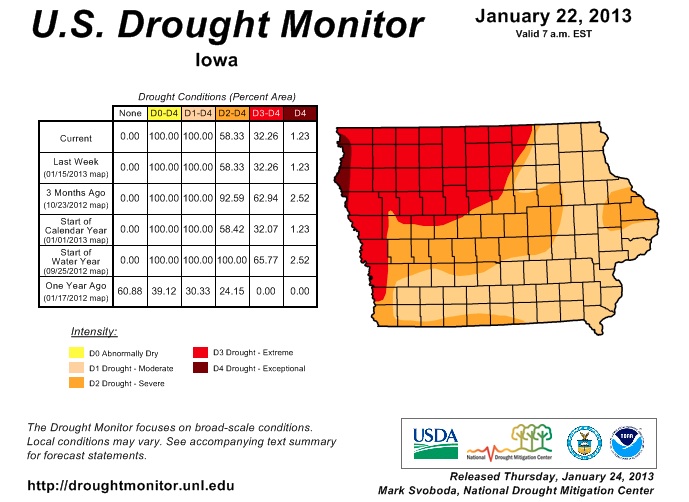
The thing that does get my attention these days though are articles such as this one from one of the local television stations. When this came across my news feed I just had to groan a little at the suggestion from "experts" that this may be a two-year drought. This past year was a bit stressful with the lack of rain, heat, and of course the rising feed prices. In the short almost five years on the farm I have seen my hog feed prices more than double! At the same time I have not doubled the prices of my products for sale and have been working very hard to improve my efficiencies on the farm when it comes to feeding.

When it comes to our heritage breed hogs it does help very much having them out on the pasture and in the woodlot, but I also find myself constantly checking the feeders and working to adjust them the best I can so that feed is not wasted. I'm also planning on doing a better job of getting the cattle into the little nooks and crannies of the farm this year (woods, corners, ditches, etc.). As far as the chicken and rabbits go it is going to be very important to keep them rotating on the pasture and foraging as much as possible.

I would love to hear what others are doing to increase feeding efficiencies whether it is for ruminants or non-ruminants!

Tuesday, January 22, 2013

Grandma Book :: The Family Farm

Whew ... Between Christmas ... Cold weather ... and most recently the passing of my Grandmother it has been busy and I have not been blogging. I'm ready to go again, but instead of my thoughts I thought it would be great to share some "blogging" from my Grandma. I assume that this was written after the effects of the Farm Crisis had hit the Book Family. At the peak my Grandpa and three of his sons were farming roughly 1500 acres with diverse crop and livestock operation. Most of that was lost ...

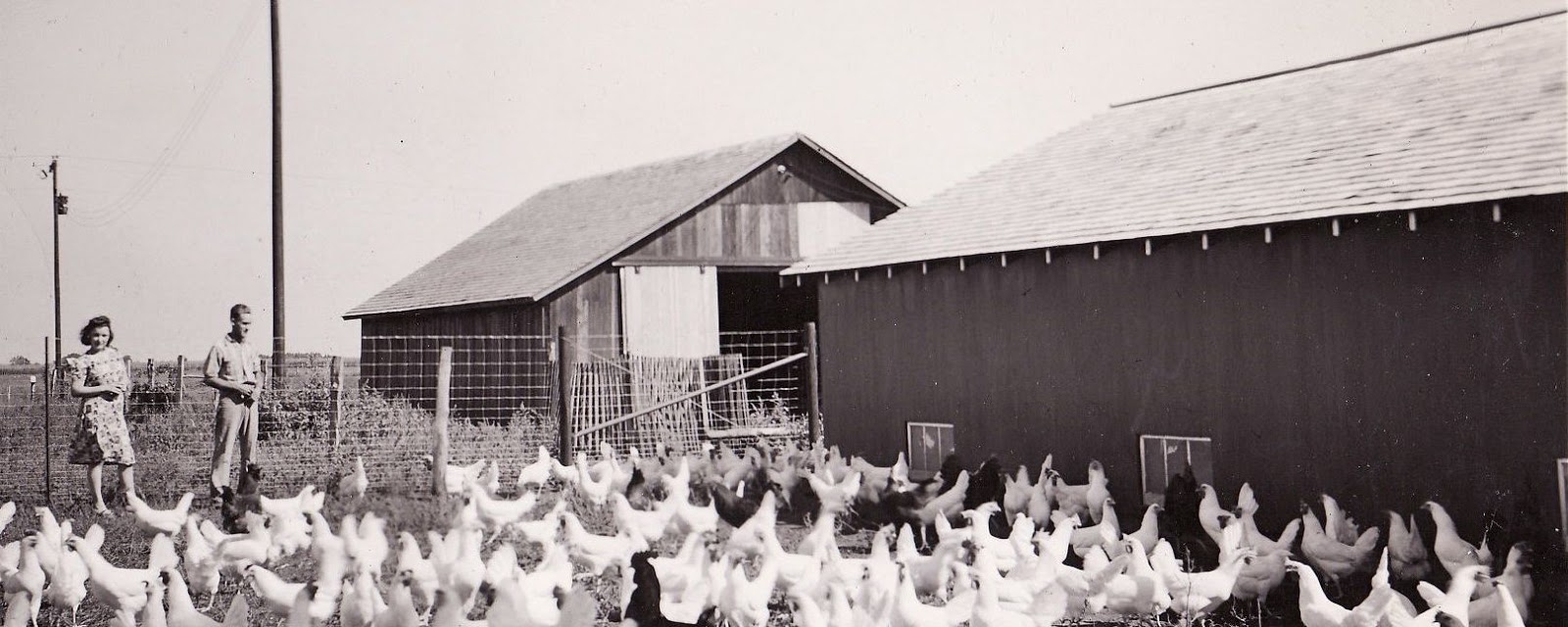
Grandma and Grandpa Book with their egg laying flock.

About The Farm Crisis of the 1980's
The Book Family is Part of That History

The farm crisis crept up on us through the affluent 1970's. In the 1970's, we farmers finally could feel equal to our city neighbors. A farmer was usually worth more than the merchant on main street. This was a new feeling for me, who had lived through the Great Depression of the 1930's, and the struggling years of the '40's, '50's and '60's. At long last, corn was over $1.00 per bushel. Soybeans got up to $7.00 and more.

In the late '60's Don and I had bought land at a high price. We paid from $400 an acre for the more rolling land to $800 per acre for the best land. We owned the home 80 acres, bought in the 1940's and paid for with corn, soybeans, hay, fed cattle, and hogs. The home place was mortgaged to make down payments. The banks were easy to get along with because land values were going up.

Don had started farming with a John Deere tractor bought with the money from cattle he fed out with his dad on the farm at Storm Lake. He married the girl he had met at Iowa State College, Pauline Kingsbury, me. We rented a half section from Bertam Holst who was a prominent business man in Boone. In fact he owned a bank. We borrowed money, and bought on time the necessary machinery to farm 320 acres in Boone Co.

After a few years Don began to realize his dream of owning land. We sold the convertible and scraped together a down payment on the 80 acres in Milford Township, Story County, Iowa.

I feel the need to remember farming all those 320 acres, feeding all those cattle, stringing the corn along in the bunks, the hired men, carrying water to the hogs, pumping water by hand from the pump west of the house. At first there was no electricity. Two sons were born, ditches were dug for water pipes after rural electricity lit up our house ... thus you get a bit of an idea of how it was before buying all the land.

Tuesday, January 01, 2013

TBF 000 :: The Semi-Short Story of Crooked Gap Farm


This is the Real Very First Episode of The Beginning Farmer Show!

About four months ago I finally decided to sit down and record the very first episode of The Beginning Farmer Show, but I didn't really want to put it out there because it wasn't very good ... in fact it was even worse than TBF Show Episode 001 which I wasn't totally pleased with either. But, I recorded it so I thought that I would at least make it available to those that subscribe through iTunes or other services.

The Beginning Farmer ShowOn this episode of The Beginning Farmer Show I share a little bit about how I got started in farming and why it all came about. I talk about my high cholesterol, my dislike of vegetables, the first cow and calf, and how this whole thing exploded. If you have never made the trek all of the way to the beginning of The Beginning Farmer Blog and you want to know a little bit about how it began then this is the show for you!

Along with the rambling in this episode I mentioned two authors whose books helped me along the way ... if you are interested in some good reading check out these links ...
As always you can follow along with The Beginning Farmer and Crooked Gap Farm by checking out these links ...
I would love to have you interact with the The Beginning Farmer Show. Feel free to comment on this post with your suggestions, questions, ideas, or even podcasting tips! You can also always reach The Beginning Farmer through e-mail.

Friday, December 28, 2012

Satisfaction and Taste

A while ago I was lucky enough to be on the panel of a screening for the film "American Meat". As far as food documentaries go this is one of my favorites (right up there with "King Corn") and I suggest checking out one of the screenings if you can! I follow their blog and facebook page from time to time just to keep up with where the film is showing and the response they are getting (and I'm hoping to find out when I can by a copy of the film for myself).

While scanning their facebook feed this morning I saw this quote, "Hard work is one of the most important ingredients in a meal." That really resonated with me so I followed the link to this article and video. The video features chef Dan Barber talking about the fact that seeing the food growing and the hard work put into raising those veggies and animals adds to the flavor. I don't know if I can explain why that is, but I have to say that I agree whole-heartdly!

There is just something great about enjoying a meal that you have worked so hard to prepare. On the farm we are able to have meals consisting of almost every ingredient originating from no more than 400 yards away ... those meals just plain taste great! I believe though that there is satisfaction and flavor to be found from putting the time into preparing a meal from a farmer that you know instead of from a supermarket aisle. There is just more flavor in a meal prepared by the hard and caring work of a cook with ingredients from the hard and caring work of a farmer you have a relationship with.

Sometimes that is the missing ingredient ...
Related Posts Plugin for WordPress, Blogger...