Showing posts with label History of Farming. Show all posts

Friday, March 22, 2013

The Book Family Farm :: Circa 1940's

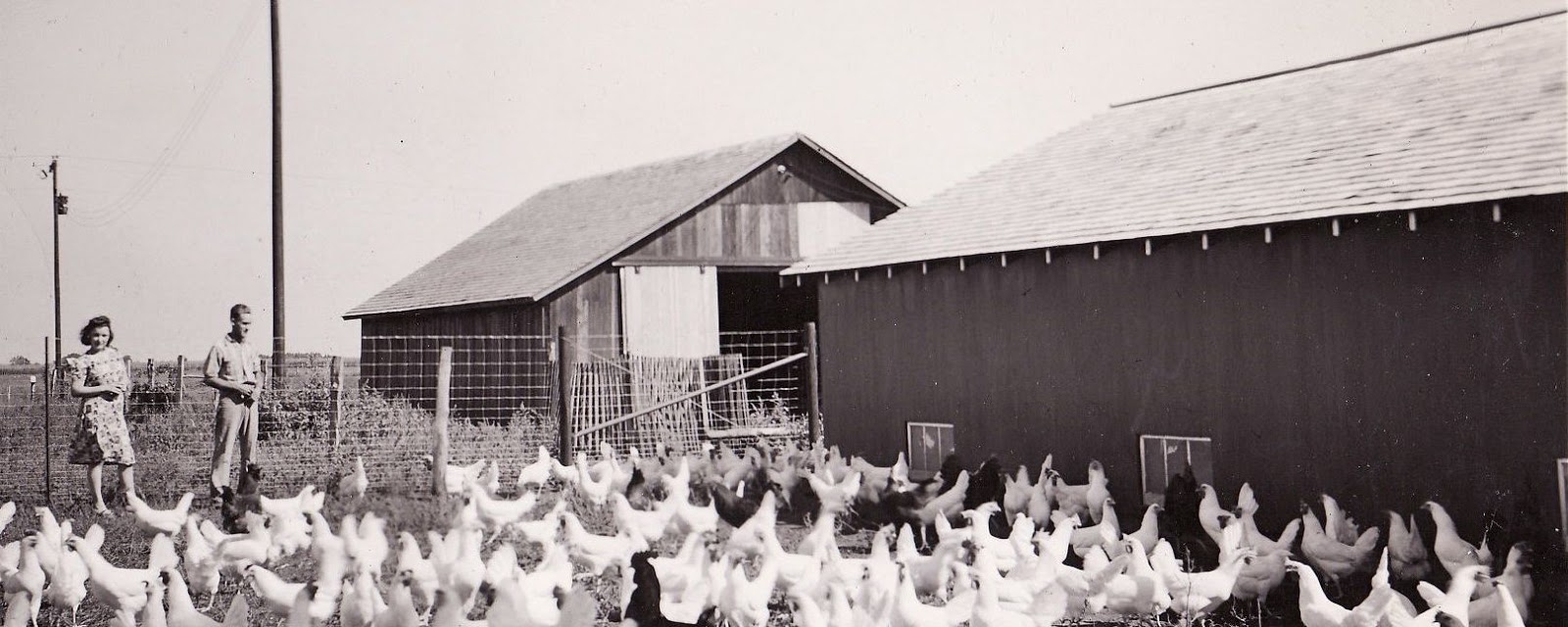
In the early 1940's my Grandpa and Grandma Book were farming on 320 acres of Boone County, Iowa land. My family is lucky because we have a pretty good pictorial history of the family and the farms ... in fact this picture of my grandparents, at what is possibly that Boone County farm, is my computer background. After the passing of my Grandma my uncle was going through lots of different files and found a handful of farming documents that he thought I would find interesting. I'm glad he passed them on to me because they are a cool part of the family history and even encouraging to me as I try my hand at farming.

Click the Image for
a Larger View
One of the coolest things that he found were some "Crop-Acreage Plats" from the years 1941 and 1942. The plats show the 320 acre farm and the crop layout planned (or actual plan used) for that year. What I find so fascinating is the diversity of crops (and livestock) that were being raised on that 320 acre farm. And ... not only was it a diverse amount of crops/livestock, but also as you can see from the picture it looks like they did their best to place crops where the land was best suited for row crops. You can see from the picture that they had just over 250 acres of crops that year.

The 1942 "Crop-Acreage Plat" has the following items listed ...

  • Soybeans
  • Alfalfa
  • Potatoes
  • Hog Pasture 
  • Corn
  • Oats
  • (And the unlabeled areas were pastures and farmyards)

While living at the Boone County farm (the would soon move to Story County) I believe my grandparents raised cattle, a large laying flock, hogs, and of course the crops. That sounds like a farm that would be fun to visit! Just a little piece of farming history for your Friday morning ...

Tuesday, January 22, 2013

Grandma Book :: The Family Farm

Whew ... Between Christmas ... Cold weather ... and most recently the passing of my Grandmother it has been busy and I have not been blogging. I'm ready to go again, but instead of my thoughts I thought it would be great to share some "blogging" from my Grandma. I assume that this was written after the effects of the Farm Crisis had hit the Book Family. At the peak my Grandpa and three of his sons were farming roughly 1500 acres with diverse crop and livestock operation. Most of that was lost ...

Grandma and Grandpa Book with their egg laying flock.

About The Farm Crisis of the 1980's
The Book Family is Part of That History

The farm crisis crept up on us through the affluent 1970's. In the 1970's, we farmers finally could feel equal to our city neighbors. A farmer was usually worth more than the merchant on main street. This was a new feeling for me, who had lived through the Great Depression of the 1930's, and the struggling years of the '40's, '50's and '60's. At long last, corn was over $1.00 per bushel. Soybeans got up to $7.00 and more.

In the late '60's Don and I had bought land at a high price. We paid from $400 an acre for the more rolling land to $800 per acre for the best land. We owned the home 80 acres, bought in the 1940's and paid for with corn, soybeans, hay, fed cattle, and hogs. The home place was mortgaged to make down payments. The banks were easy to get along with because land values were going up.

Don had started farming with a John Deere tractor bought with the money from cattle he fed out with his dad on the farm at Storm Lake. He married the girl he had met at Iowa State College, Pauline Kingsbury, me. We rented a half section from Bertam Holst who was a prominent business man in Boone. In fact he owned a bank. We borrowed money, and bought on time the necessary machinery to farm 320 acres in Boone Co.

After a few years Don began to realize his dream of owning land. We sold the convertible and scraped together a down payment on the 80 acres in Milford Township, Story County, Iowa.

I feel the need to remember farming all those 320 acres, feeding all those cattle, stringing the corn along in the bunks, the hired men, carrying water to the hogs, pumping water by hand from the pump west of the house. At first there was no electricity. Two sons were born, ditches were dug for water pipes after rural electricity lit up our house ... thus you get a bit of an idea of how it was before buying all the land.

Tuesday, November 18, 2008

At the Neighbor's Farm...

Last week I received a call from one of the guys at our church who lives out on a farm. He told me that he need to clean out his wire corn crib and was wondering if I wanted the ear corn that was still left in it. Of course whenever there is the potential for free feed I'm interested so I jumped on the opportunity. Well, yesterday it was finely dry enough for me to go over and get the corn so I hooked up the barge box wagon to the back of the truck and headed over.

I'm very glad that I was able to go over and get that corn because it will be nice to have, but also for a few other reasons that are less about the feed. First of all it was nice to be able to lend a hand to a friend, brother in Christ, and neighbor. They actually live on the same road as we do, except our two portions of the road are not connected! I didn't save him a ton of work, but it was nice to be able to spare a couple hours in the morning to help get the job done more quickly.

The other great thing about helping out was that I was able to hear some great history. The farm that this family lives on has been in the "home place" for over 150 years now. His great-grandparents moved out from Pennsylvania in 1854 (or 56, I can't remember exactly) and had a land grant of 160 acres. That first year they built a log cabin and would soon after build a L-shaped house because they needed the room for their 13 children. When they arrived much of the land was wooded and they cleared out what they needed as they needed it. He also mentioned that his grandmother would tell them about the Indians in the area that would take clothes from the laundry line!

Around 1917 they built another house, which is the one that stands today, and moved into it (I'm not sure if someone continued to live in the original house). And now, over 150 years later this same land is still being farmed by the same family. Not farmed on a large-scale by any means, but they do raise some cattle and this year he planted 20 acres of corn (the reason the bin needed to be cleaned out).

Today he is planning on picking corn with his two row New Idea picker. If I can't free up some time and get a new belt for the power steering pump on my tractor I would love to go help out by pulling some wagons for him. I have a feeling that there is a lot to be learned over at that farm ... including some more history.

Saturday, November 15, 2008

Looking for Some Reading Suggestions...

It's a Saturday, and a very busy Saturday at that (it's the annual Harvest Dinner at church)! So, I thought I would just take a second today to pop in and throw out a request. If you read yesterdays post (and others about "Harris on the Pig") you will know that I'm just love that book and the fact that it is book that was written over one hundred years ago. So, with Christmas coming soon and my families looking for list ideas I was wondering if anyone knows of any good agricultural books that I should check out. Something from at least the 18th or 19th century.

Also, thanks for the responses from yesterdays post about feeding boiled feeds to pigs. If you haven't yet, you should check out that link that Rich posted. Not quite as old as the book by Mr. Harris, but it looked like some interesting reading if that is your kind of thing.

Tuesday, January 29, 2008

The Importance of History

There are a few things that I am really passionate about. Of course my family and my ministry top the list. Farming is at the top of the list also, but the next thing I am passionate about is history. I have always love history, even as a very young child. In fact I am most interested in pre-1900 American history with an emphasis on 18th century stuff. It is interesting though that my passion for history also spills over into my other passions. I love to learn about family history and how families lived and interacted throughout history, I am always looking at my ministry from a historical perspective trying to learn from the past and preserve the past ... but, I really see my passion for history crossing over when it comes to farming.

Recently I picked up the book, "Harris on the Pig :: Practical Hints for the Pig Farmer" by Joseph Harris. This book was originally published in 1883 so it is over 100 years old. The thing that strikes me most is how practical the information is. But, I can also see that when it comes to pig farming our modern farmers have strayed away from this great knowledge of what just plain works.

What often happens in the rush to produce more and produce more quickly is that the tried and true ... the history ... is lost. I sort of mentioned this type of thing the other day when I talked about Gearld Fry's article on keeping the heritage breeds. What has happened (and not just in farming) is that the younger generation leaves the farm in order to go to college. Many of this generation have gone and earned agricultural degrees or at least immersed themselves in the latest and greatest, so when they get back to the farm they feel the need to change everything. I think they feel they need to change because they think there is more money out there that they are missing ... or maybe because they believe there is an easier way to do things ... or even just because that is the way that everyone else is starting to do it!

But, for whatever reason they change the way the farm has been run. They begin to specialize. They begin to upgrade their breeds through crossing in order to have the highest production possible in the shortest amount of time (disregarding other factors such as cost and efficiency). They begin to move the farm away from a diverse entity into a mono-crop or mono-animal production plant. And what happens is that history, what has worked in the past for year after year, is forgotten.

Now, I will admit that I tend to the nostalgic from time to time ... but, I do realize that there is a place for innovation. But, I want to see innovation rooted in history. Take Ultra High Density Grazing for example. I think it is safe to say that is an innovation that is starting to take off right now. And on the surface it seems like something new ... until you pop in that old VHS of "Dances With Wolves". They American Bison herds were doing Ultra High Density Grazing for years, they were just doing the paddock shifts themselves! Wow, now that would be innovation ... cattle that did paddock shifts for themselves. There are many more examples of how farmers and people in other professions have taken a page from history to produce innovation, not just changed for the sake of change.

So, I would call myself a beginning farmer. I would say that I am striving to become a sustainable farmer. But, I think I would like to add that I am going to be a historically minded farmer!
Related Posts Plugin for WordPress, Blogger...