Showing posts with label Drought Management. Show all posts

Tuesday, May 14, 2013

Stay Off the Grass!

Here we are on May 14th, 2013 and, as you can see from the picture above, the only animals on my farm enjoying the bounty of the pasture are the chickens and the rabbits. In fact it is all that I can do to stop myself from turning the cows and sheep out on the pasture ... especially since I'm purchasing small square bales of hay about every 10 or 12 days! But, I know that it is for the best because my pastures are just not to the point they need to be for them to be grazed.

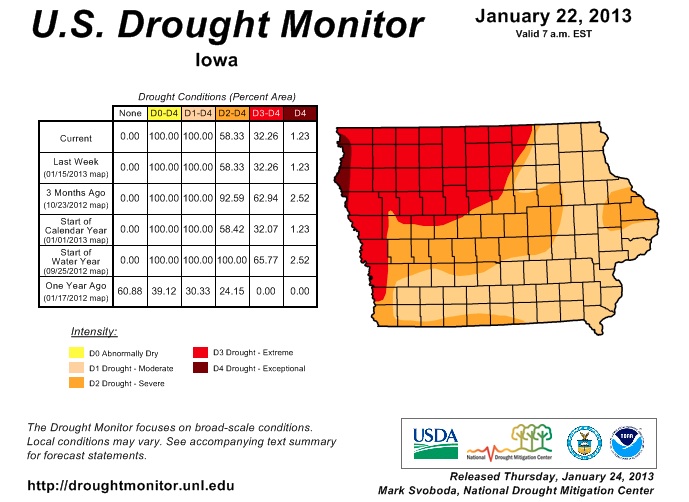
I believe there are a combination of factors that have my pastures lagging behind a little bit this spring. First of all it has been a cool spring (we had 9 inches of snow on May 4th). That has kept everybody's pastures growing slowly, but especially mine that still have a large amount of warm season grasses as the main forage (even after 4 years of intensive rotational grazing). On top of the cool spring combined with the warm season grasses there is the whole issue of the drought of 2012. I ran my pastures pretty hard last year, and if I am going to be truthful with myself I used them up a little more than I should have. So, even though as you can see from the picture below that we are statistically out of the drought I'm still paying the price.

All of this has led to me having to make the painfully tough choice of keeping my cattle and sheep off the pastures and up at the house still eating hay. Each day as I drive to town for work I see what seems like every other farmers cattle out grazing while mine are still eating expensive (still have drought prices here) hay. And, each time I see those cows grazing I try to tell myself that I could put them out on the pasture and just give them bigger paddocks while feeding a little hay still. In my "want to get grazing" mind that seems like the perfect solution, but in my "need to do what is best for the longevity of the pastures" mind I know that I need to just hold off and let them heal as we keep getting some decent moisture this spring.

How are your pastures? Has the cool spring kept them from taking off? Did you do a better job managing them last summer than I did (most likely you did)? I'd love to hear your thoughts on the subject.

Tuesday, January 29, 2013

There Was a Time ...

Not that long my main concerns with the days weather was if it would interfere with my days outdoor plans. I worried about things like cold fronts and warm fronts because of how they may effect the fish bite ... I worried about rain because it might cancel my slow-pitch softball game ... and I worried about snow because then I would have to shovel it. These days things are a little different ...

Although I'm not constantly checking the weather because I find that there hasn't been much I could do to change it I do find myself looking ahead and trying to plan around the freeze and thaw that we experience here in central Iowa. For example ... if I have a choice of moving big round bales or pulling three tons of feed in my feed wagon I would rather do those things when the ground is frozen as opposed to when there is a nice layer of slick mud!

The thing that does get my attention these days though are articles such as this one from one of the local television stations. When this came across my news feed I just had to groan a little at the suggestion from "experts" that this may be a two-year drought. This past year was a bit stressful with the lack of rain, heat, and of course the rising feed prices. In the short almost five years on the farm I have seen my hog feed prices more than double! At the same time I have not doubled the prices of my products for sale and have been working very hard to improve my efficiencies on the farm when it comes to feeding.

When it comes to our heritage breed hogs it does help very much having them out on the pasture and in the woodlot, but I also find myself constantly checking the feeders and working to adjust them the best I can so that feed is not wasted. I'm also planning on doing a better job of getting the cattle into the little nooks and crannies of the farm this year (woods, corners, ditches, etc.). As far as the chicken and rabbits go it is going to be very important to keep them rotating on the pasture and foraging as much as possible.

I would love to hear what others are doing to increase feeding efficiencies whether it is for ruminants or non-ruminants!

Thursday, September 20, 2007

Quality Pasture :: Chapter 8 Book Report

Yesterday I finished reading chapter eight of "Quality Pasture" by Allan Nation. This chapter was entitled Climate and it's Effect. It was a pretty interesting chapter dealing with temperature, precipitation, and more. As with other chapters it spent a decent amount of time discussing applications with grass based dairy operations, but I also noticed a slight focus on the southern part of the United States which makes sense because I believe he is based in Mississippi.

One thing that I found especially interesting in this chapter was his discussion of shade. Mr. Nation's contention was that shade is not always needed. He spoke about the ability of cattle to adjust to climates when they are given time and the fact that it is still the same temperature under the shade as in the sun. He believes that you either need to have plenty of spreed out shade for your entire herd or none at all. Another thing he points out is that if you are going to use trees as shade devices they should have all branches trimmed twenty feet up. This will make the shade move quite a bit during the day and will force the cattle to spread out during their day. Another interesting idea he gave was to give cattle multiple small breaks of grass during hot days. His contention is that cattle will forget about the heat if they have enough tasty food.

He also gave a lot of great tips for drought management. The thing about a drought is the question isn't if, but rather when it will happen. He writes about needing to have a drought plan in place early on in your Management Intensive Grazing progression. It is important that you begin building up a stockpile of stored forages right away because feeding hay in a drought instead of letting them to continue to eat down your suffering pastures will help those pastures bounce back so much more quickly when you finally do get rain.

I'm looking forward to the last few chapters of this book. I have continued debating in my mind the differences between Mr. Nation's high input methods and the lower input method of Joel Salatin. The more I read the more I appreciate the ideas of Mr. Salatin and I can't wait to put them to work and see some of the results with my own eyes ... that being said, I think my dad will be putting some lime down this fall or winter in order to jump start some pastures for the animals and for our hay. We will see how that goes for our farm.
Related Posts Plugin for WordPress, Blogger...