Friday, June 05, 2009

Not My Favorite, But...

I can't say that our current bull is my favorite Dexter bull, or even close to that. He has give us plenty of frustration with his desire to get out and roam around and he isn't exactly as cuddly (not that you should ever cuddle a bull) as some Dexter bulls that I've bet. But, with all that being said he does have a few redeeming qualities that I don't hate.

He seems to have fleshed out nicely on the spring grass so far (at least comparatively speaking) and it also seems like he is a guy that will get his job done. One other thing is that he is a little smaller in size so I'm hoping he will bring us a couple smaller calves from our two bigger cows. Our big cows hardly even seem like Dexters when you compare them to the others in the herd!

All that being said, I'm still on the hunt for a herd bull that fits us perfectly and will continually improve our herd. We have an uphill battle to get the herd to where I would like it, but this is an okay start.

Thursday, June 04, 2009

Putting Together a Pasture Mix

As the cows have gotten out and grazed our pastures this spring I have really started to notice how much work they need. I have mentioned previously that our 40 acres was in the Conservation Reserve Program for at least 13 years before we purchased it and in that time nothing was really done to it besides the initial seeding of switch grass and various prairie grasses. As you look over the ground on a whole late in the summer you see plenty of tall prairie grass, but once it has been grazed and once you take some time to walk through it you really begin to understand how overgrown everything is with brush and weeds.

Which leads me to my question. Do you have any thoughts on a good pasture mix that I could broadcast on before or after the cows hit an area? I attended a little round table discussion on the subject at the PFI conference this winter and I need to find my notes from that because I realize that this is a subject that is very regional. But, I know that there are people around my neck of the woods that read this blog and I always love to get ideas from other parts of the country.

What kind of grasses, legumes, and even weeds (or at least what some people call weeds) have you had the best success with? And, do you have any suggestions for seeding down areas? Now might not be the best time I realize, but I would like to tackle this as much as possible.

Wednesday, June 03, 2009

New Grass, An Expecting Sow, and Little Calf

Soccer came to an end last night, but things don't look like they will be slowing down anytime soon. In fact I expect things will get even busier this summer as we tackle all the projects that need to be done and continue with our daily chores. As you can see from the picture on the right (you can click on the image to make it larger) the dexter herd is out in new grass and enjoying it. Although, the still like to come up to the short stuff and hang out in the cool of the morning it seems.

One thing about the tall grass is that it is nearly impossible to find a itty-bitty dexter calf that isn't even knee high! Last night I spent about 30 minutes looking for him in the dark and finally found him about 10 yards on the other side of the fence just sleeping away in some bushes. This morning I couldn't find him either and was sure that he was outside the fence again so I started wandering around and looking. I didn't find him until I almost stepped on him!

And finally, here is a picture of our Hereford sow that looks like she is about ready to burst. She is due to farrow on June 6th so we are keeping a close eye on her. The good thing is that it isn't hard to keep track of her because she only comes out of the hut a few times a day for water and food. I really can't wait to see some little red Herefords bouncing around the farm!

Sorry for the late update, but now that soccer is done I should be able to get back on my normal schedule...

Tuesday, June 02, 2009

The Hog is in the Hut

I don't have a picture to show you of our sow living in her new digs, but I will get one soon. As with everything on the farm this project took a little longer than expected, but the main thing is that it is done and she still hasn't farrowed yet. She seems to love the little hut because she has only come out a few times a day since I put it in there on Sunday, of course she looks like she is about ready to pop so that might have something to do with the fact that she likes laying around and hanging out in the hut.

The hut ended up being a very basic A-Frame that is eight feet long and seven feet wide at the base. There is a door in the front that I can close and latch if I need to check the pigs and want her out, or if it is cold and I want her in. The back as a drop down vent that I can open to get some of the warm air out and provide some air circulation. Other than those details the entire thing is just covered with 1/2" treated plywood and it stays dry inside (I know because it rained quite a bit last night).

One thing that I already know I'll probably change in the future is to put it on some skids that are a bit more substantial that pine 2x4's and maybe even try to use oak instead of the pine period. I had also looked at the possibilities of making one of the sides hinged so I could have easy access to the pigs, but with the materials that I had at the time I didn't like any of my options.

The great thing about this design is that I can use it as a test. I can see what works and doesn't work and then I can make whatever improvements I need to make on the next one. Now, all I have to do is wait for some pigs to be born ... we just keep checking.

Monday, June 01, 2009

New Life


They say a picture is worth 1,000 words. Well, that is the case today because this picture tells it all. The first little Dexter calf was born on Stoneyfield farm sometime late Saturday night and everyone is doing wonderful.

When I went out to do chores Sunday morning before church I found all the cows up waiting for some water ... all the cows except for one that is. On Friday I had noticed that our newest cow (that came with the bull from Nebraska) was really starting to bag up and she looked like she would be calving soon. I'm glad to say that I was correct in my assumption, because I found them down in the valley just hanging out and enjoying some nice mother/son time.

If all went well last year we should be coming up on some more calves in the near future, but I sometimes wonder how many cows our previous bull settled. We will see for sure in the next month or two. Not exactly the schedule I wanted to keep, but we will get things back on track over time.

Tomorrow I'll share an update on the hog hut, and I bet I'll have some pig news soon as well!

Saturday, May 30, 2009

I Can't Do it Alone...

Just to prove the point that I have made many times on this blog, that I can't do it alone, here are a couple pictures showing some recent work being done on the farm. In the first picture you see one of our great church friends helping till the front yard so it could be seeded to grass. While he was here he also tilled up the garden and now we have plants starting to poke through the dirt. In the second picture you can see my helpers hard at work on the hog hut with me. I only had a few minutes to work in between soccer practice and doing the opening prayer at the races, but my helpers helped make the most of my time! Thank goodness for those willing to help out...

Friday, May 29, 2009

Friday Link Round-Up

From time to time people drop me a note and let me know that they enjoy the blog and share some of their expertise with me. It is wonderful to hear words of encouragement, but it is even more exciting when I get to hear about what other people around the country are doing or want to do. Thank you so much for the e-mails and comments and keep them coming! Lately I have collected a few new links that I wanted to bring to your attention and that I will place over in my links section.
  • The Farmers Forum: I want to encourage you to visit this site that our blog friends down at Nature's Harmony Farm started. It kicked off with a lot of action and a wealth of information, but I must confess that I have neglected it for a while now. So, go check it out and let's make use of the amazing amount of information that can be gleaned from a forum full of farmers.
  • Yeoman Lawyer: Yeoman is a frequent commenter on this blog and always is very encouraging and insightful. Lately he has also been rather bloggy! The topics on his blog don't all have to do with agriculture in a specific sense, but I think they are all applicable. Also, be sure to check out his post about Victory Garden posters!
  • The Yeoman Farmer: Don't get this blog confused with the previous one, but it is a great blog to check out by a farmer who is living out many of the ideals of Thomas Jefferson's "Yeoman Farmer". Lots of great posts about life on the farm and life in general.
Are there any other links or blogs that generally deal with agricultural that you check out daily? I would love to hear about them!

Thursday, May 28, 2009

The Tech-Savy Locavore

I realize that probably not to many readers of this blog have an iPhone (although I would take one if anybody is donating them ... just think how much more blogging I could do then), but for a few days now I have noticed that the iPhone application Locavore 1.01 was the App Store pick of the week last week. If you don't follow the whole iPhone/App Store world this basically means that someone at Apple has picked out this little program to highlight at their App Store.

As far as I can tell the Locavore application works best with the iPhone at the moment because of it's GPS requirement, but it is a pretty cool little application and I think it says a lot about the mainstreaming of eating local. Of course you can use it with your iPod Touch, but it won't be able to tell your location and you will just have to search for things in your area.

What this little program can do (with the help of your iPhone) is let you know what things are in season near you, what is coming into season, where a local farmers market is, and even links to Epicurious receipes (it seems like there was a post about his over on the Epi-Log). If nothing else I think it gives some more publicity to the local food movement and I think that is a good thing.

Now, if only I could find a way to get an iPhone without going broke ;)

**Also, be sure to check out yesterdays comments for a great response from Jim Gerrish. I am so thankful that he has taken the time to share on the blog!**

Wednesday, May 27, 2009

A Note From Jim Gerrish...

Way back in November of 2007 I wrote a couple of posts on Ultra High Density Grazing (post one and post two) and mentioned the work of Greg Judy and Jim Gerrish. I have to admit that I was and still am equally amazed and interested in the idea of Ultra High Density Grazing and all of the things that go along with it. But, the other thing that I am willing to admit is that I don't have a very good understanding of the methods, terminology, and everything else. Thankfully there is a thing such as Google and also wonderful people such as Mr. Gerrish who are willing to take some time to set me straight!

Yesterday I received an e-mail from Mr. Gerrish that helped me understand a few things. Here is a sample of what he wrote:
"The 2000 to 8000 lb per acre I was referring to is the standing forage yield. Basically 1 to 4 tons per acre of standing stockpiled forage."

"We generally graze winter stockpiled forage at a stock density of 120-140,000 lb-liveweight/acre with daily moves. On really heavy stockpile, we’ll occasionally break 200,000 lb liveweight/acre. Greg [Judy] usually moves three or four times per day. His reference to 500,000 lb liveweight/acre stock density is an instantaneous measure. If he moves 3x daily, the 24-hr stock density (the only way to accurately relate animal needs to forage supply) is 166,667 lb/acre. If he moves four times daily, the 24-hr stock density is 125,000 lb/acre. We are basically grazing at the same carrying capacity and 24-hr stock density. He does it with multiple moves each day. I do it with a single move (basic laziness on my part!)."

"We usually graze 300-500 cows in the winter and our daily chore time is about 25 minutes. That chore consists of taking down one 1000 ft section of polybraid and leapfrogging it ahead for the next day’s move."
That helped me understand what he is doing a lot, and it has given me a lot of encouragement in what we are hoping to do. Hopefully this is something we can work towords. In fact is something that I started doing with our 5 heifers this morning because I wanted to clip the grass really short in the area where we are going to be building a shed. The mower isn't going yet, so I might as well use cow power and not waste the grass!

Any good book recommendations on this subject that you have read? I would love to hear them...

Tuesday, May 26, 2009

The Building Continues

I've probably said it over 100 times on this blog, but sometimes things don't always go as you plan! I had planned to get the hog hut done on Saturday and have everything ready to go by Sunday at the latest. But, sometimes things just don't go together as planned and then sometimes it starts raining and you don't have a shed. Which is all to say, I don't have the A-Frame hog hut done yet, but I'm getting dangerously close! All that is left to do is attach the plywood, the hardware (hinges, latches, etc.), and put it out with the momma-to-be.

I ended going up with the plain A-Frame design pictured above (and linked here) for a couple of reasons. First of all, it is a plan from the 1930's so it is something that is tried and true and still in use today. That must mean it works alright. Secondly, I decided to try this one first because it was easier to build. I had hoped to build the E-Hut style, but it is a little more involved and I wanted to make sure that I had materials that would last when I built one that took that amount of time.

This A-Frame looks like it will serve its purpose well though. I have followed the basic dimensions of the design, although I have made a few changes because I am using plywood for the covering instead of barn boards. Also, I have only put a pig door in one end, but I will have upper vents on both ends, and I will be able to lift one of the sides (I think) in order to get inside more easily to process the pigs.

Once it stops raining and I finish things up I will post some pictures.

Monday, May 25, 2009

Victory Gardens


In honor of Memorial Day today I found this very short video on Victory Gardens. You can read more about Victory Gardens on Wikipedia, but if you have any historical facts and on them I would love to hear them!

Saturday, May 23, 2009

Take it From Me: Lessons Learned 6

Okay, this is the last lesson for now, but I think it is one that I have thought of most often ... Just get out there and farm! Now, I'm not saying that whenever you have the urge to farm you just drop everything and head to country, but as you have heard me and others say from time to time on the blog you just need to get out there and do it sometimes.

As soon as we started to have the farming idea takeoff in our minds I started filling my mind with as much information as I could. I read and read and read and read! I had conversations about farming with trusted family members and we started to formulate plans. But, then we hit a point where it just need to happen or not. So, we bought a farm, moved to the country (eventually after the house building help of many), and decided to build this farm from the ground up.

Now, since it is Saturday and I don't have too many obligations I am going to go farm. In this case I'm building some pig shelters and a new area for the sow...

Friday, May 22, 2009

Take it From Me: Lessons Learned 5

Never give up. Plain and simple one of the biggest lessons that I have learned and it is one that I always desire to pass on to everyone that I meet (especially my children and all the students I work with). Over the course of building the farm (which still is not complete, nor will it ever be) there have been many times when I felt like it might be time to give it up. When we have faced set backs, blocks in the road, or when it just plain felt like it would never happen there have been twinges of doubt that would creep into my mind.

I understand that there may come times when the best result is to step back and reevaluate, but that does not mean giving up. That may just mean that we need to make changes for a time or recognize that our passions aren't matching up with our farm, but it does not mean we just throw up our hands and throw in the towel.

Farming (as much as I have learned) is a process of ups, downs, and not many "normal" days. There are times when that sort of life can bring a person down or at least make them think that things just aren't working out. I have tried to learn from of the downs and apply them to our farm! But, know this ... I'm not giving up!

Thursday, May 21, 2009

Take it From Me: Lessons Learned 4

This is one of the lessons that I have really begun to appreciate the deeper we get into our farm. The lesson that I have learned is that farming is not a solitary occupation, or at least it should not be a solitary thing. Really I can't do this on my own and I don't even think I should be trying to do it on my own. In fact I'm I think the solitary society that we have created recently in our American culture is kind of not the right thing...

The biggest part of my help comes in the form of my wife (and even my kiddos). She helps with the fencing, getting escaped animals back in, daily chores when I'm busy, encouraging me, helping with the farm plans, and so much more. Our extended family has also been a huge help and encouragement as we set out on this journey.

But, the help doesn't end there. I think one of the greatest things about farming is and should be the community that comes with it. I know that I have received amazing amounts of help from my friends and neighbors and I am beginning to have opportunities to share the love. Right now I'm on the receiving end of so much help and I am very thankful for it.

As we grow on the farm it is my desire to continue the tradition of community that has been a cornerstone of agriculture of centuries. It just works...

Wednesday, May 20, 2009

Take it From Me: Lessons Learned 3

I guess this is starting to become a little series, but I think that is a good thing. Not only does it hopefully help others that are beginning or are contemplating beginning a farm, but it also helps me put things into perspective. Sometimes I need a little reminder of the lessons I have learned and what I need to do to apply those things. Today's lesson is, "knowing when to say when," and it is one that I continually need to be working on. The people pleasing side and the dreamer side of me don't like to say no.

It doesn't matter if you have left your job and thrown yourself completely into the farm or if you are like us and you are combining your town job and your farm job the skill to know when to say enough is a very important thing. When you make the decision to begin a farm it is something that you need to recognize will take a lot of time, effort, passion, and energy. If you are constantly saying yes to things that take away from your main farm goals (whether they are farm related things or otherwise) you are putting yourself in a difficult situation.

Some of you may know that in the spring for the past five years I have coached varsity girl's soccer at the high school. This is something that I absolutely love! I love the interaction with the players, the parents, and the school staff. I also love the job of coaching and teaching these girl's about the game (and even life). The problem is a high school varsity sport takes quite a bit of commitment. Five days of practice or games each week for ten weeks, and when there are games I'm usually gone all day (until around 9:30 PM). I need to be able to objectively evaluate things like this and seen where I should be spending my time.

But, learning to say no isn't just about off farm activities. On the farm there are a LOT of things that I would like to do. There are different livestock options I would like to add, projects I would like to do, and things I would like to take on. For example, as badly as I would like to add some broiler chickens right now (or four weeks ago) I need to stick to my "no" guns and realize that now is just not the time. There are other things that need to take priority.

For a guy like me that loves to dream and look towards the future learning to say no is a difficult thing, but it is a thing that I need to do!

Monday, May 18, 2009

Take it From Me: Lessons Learned 2

Yesterday I wrote about the importance of patience when you are beginning a farm (or living your life), today I wanted to share another lesson that has become very evident to me. The thing about being a beginning farmer, like myself, is that there are a lot of things I don't know. I have tried to fill the void in my farming brain by reading as much as possible and seeking out all the information that I can find. But, let me just tell you ... there is no replacement for the joy and increase of knowledge that can be found by seeking out other farmers and picking their brains.

Here in Iowa I have the benefit of an organization like The Practical Farmers of Iowa that has helped me connect with and meet other farmers that have similar goals and practices that we desire to have for our farm. I have been able to ask questions, observe their farms, and generally pick up as much knowledge as I can.

But, there is also the huge benefit of living in an agricultural state that has farmers all over the place. At our church there are many farming families (mostly farmers that also have town jobs) and they are a wealth of knowledge. I may not want to duplicate their some farming practices on our place because we have different farming goals with our direct marketing, but that doesn't mean that I can't learn TONS from them. Many of these farmers have done the same things we are working on doing now (some have just moved up to "bigger and better things") and their knowledge is priceless.

So, my lesson learned ... seek out and connect with other farmers. Gather that knowledge, ask them questions, and apply what you learn because often times what you can learn is gleaned for years and years of experience!

Take it From Me: Lessons Learned

Now that we have have been living on the farm for over six months, owned the farm for over a year, and started this thing over two years ago I think it is time for me to offer some lessons learned from time to time. Of course there has been a lot that we have learned over the past couple of years, but specifically I want to share some lessons that pertain specifically to beginning the farm and getting everything going from scratch. Today's lesson ... patience is a good thing!

As I was standing out in the sprinkles yesterday moving a fence for the five heifer calves so they could have new grass (and because they were out already) I realized how many of our struggles and problems could have been avoided by a little bit of patience. For example ... we bought our first Dexters before we even had a farm, we bought our first pigs before we had their pen completely built, and then we moved the Dexters to the farm before we had any perimeter fence built. On top of that we could really use a shed/barn of some sort to keep everything out of the weather.

In a perfect world where I was perfectly patient I would say that by now it would be best if we only had our chickens and a few pigs. Then as we had our fencing in and a shed up we could start bringing in the cattle. But, it is not a perfect world and I am very far from perfectly patient! I admit that I really just wanted to get this farm going and in doing so I pushed things along a little too quickly.

So, my advice to others wishing to begin a farm: Get the basics in place before you get going. On the surface I thought we would get a jump start on our cattle herd because that is something that takes time to grow, but in reality we would have probably been equal with or even ahead in the game if I had just slowed it down a little bit. Make sure you have the fence in, water figured out, shelter from the storms (if needed), and a plan. We just had some of that (water and a plan with some holes).

Saturday, May 16, 2009

You Don't Always Get What You Pay For

That could be the title of the post I read over on Allan Nation's "Stockman Grassfarmer Blog". You can check the post out for yourself, but this little bit really says it all:
"The Truthful Labeling Coalition estimates that American consumers annually spend an estimated $2 billion for added salt water in commercial grade chickens, The Wall Street Journal reported. Currently, roughly one-third of fresh chicken sold in the USA is "plumped" with water, salt and sometimes a seaweed extract that helps the meat retain the water."
The poultry companies claim that they have been forced to go this route (have no reason to doubt them) because the large chains want a uniform product and by adding as much as 400 mgs of salt per 4-ounce serving they can get that uniformity. The rub for some people is that the companies are still allowed to call these "plumped" chickens 100% natural or all natural.

I suppose you could say that salt is a "natural" thing, but finding it in such high amounts in a serving of chicken is pretty unnatural I would think...

Friday, May 15, 2009

No Control!

On the farm we are continually to the mercy of so many things. It seems we are always dealing with the consequences of the wind, snow, cold, rain, mud, escaped animals, lack of infrastructure, time constraints, daylight, and so much more. This week it has been the rain! In fact since midnight we have received well over 3/4 of an inch and as I type right now it is still raining (although I think we are getting to the end of this round of showers). All of this rain really is a double edged sword though.

On one hand it I know that I should never curse the rain because then I will complain when it is gone, but in our situation it really does hinder our progress. I suppose on a farm that was all set up this much rain would be a hindrance, but it wouldn't bring all progress to a stand still. This weeks plans included the tilling and seeding of our front yard (a much needed project), but now we just have a lake again in the front yard.

The rain also slows down our perimeter fencing preparations because I haven't been able to get to a few places to clear out some brush and get ready for the corner posts. On top of all that the rain, and more importantly the mud that it brings, will slow down the progress on our new shed. They have not started yet, but everyday that it pours like this our project gets pushed back a little.

But, I will say this about the rain ... as I walked around the fence this morning checking on the cows in my mud boots and rain suit I did enjoy the sound of the rain. I think just about every type of weather or condition is beautiful in it's own way on the farm and I'm thankful for all of that beauty!

Thursday, May 14, 2009

Giving Local a New Meaning...

Even though I'm not writing for the Epi-Log I still love to check in and comment when there is something there that really piques my interest. Such a post popped up yesterday from James Oliver Curry. He wrote about a recent New York Times article that outlined a new emphasis by Hunt's and Lays Chips on the local ingredients they are using in some of their products. This quote from Mr. Curry's post sums up the idea:
"The New York Times today ran an article about how the folks behind Lay's potato chips (Frito-Lay is owned by PepsiCo) and Hunt's canned tomatoes (ConAgra) are placing the spotlight on the local people and communities involved in making their products (carefully worded not to say "locally grown"). Yes, some potato farmers in Florida supply the ingredients for the chips that are made in Florida. But does that count? Local to the manufacturing plant? Local to Floridians? Am I a locavore if I eat a Lay's potato chip in New York? That's stretching it."
This particular post hasn't drawn a ton of comments just yet, but I would be interested to hear what your thoughts on the subject are. On one hand I can understand the comment that says that it is good that they are at least building the local economy by using things from local farms and employing locals at their plants. But, there is also a strong point with the other side that says calling something like a potato chip local may be a bit of a stretch.

To me the big question is what is the motivation. Are these companies trying to jump on the "localvore" bandwagon just like large corporations jumped on the "organic" bandwagon recently, or are they just trying to highlight the fact that they have American employees?

Wednesday, May 13, 2009

Price Maker or Price Taker?

One of the many wonderful benefits of being a member of the Practical Farmers of Iowa is their quarterly publication. The thing about a member driven organization like PFI is that when it comes time to collect articles for their mailings they can turn directly to the membership and use the practical knowledge of our farmers right here in Iowa. That is the case of an article from the Spring issue that really caught my attention. It is titled, "How to Be a Price Maker v. a Price Taker: Ideas for pricing Meat," and it is written by Ryan and Kristine Jepsen who run Grass Run Farm.

This one really hit me between the eyes because I feel like we have started out in the price taker position because I came into farming with the fear of not being able to sell our product. Despite all the reading I have done about the importance of recognizing that farmers deserve a decent pay for the work they put in I have been scared by the cheap products we see in the grocery store. Over and over I have been reminded that if we are going to do this successfully we are going to have to make a profit, and in order to make a profit we are going to have to make a decent return on our time and inputs.

The main thrust of this short article is that you need to know your stuff. You need to collect as much information and data as possible and use that to set your prices and be willing to share it transparently with your customers. Collect receipts, track the time you spend, know your carcass yields, find out how much you need to gross per animal, and learn what your customers are looking for.

I think this sums it up well:
"We've found it most valuable to communicate these uncertainties to our customers and be transparent about how we make our living. It's not easy for the end client to understand that under our worn plaid shirts and (dusty) jeans, we're farmers, salespeople, inventory managers, truck drivers, graphic/website designers, bookkeepers, business analysts, and family members who routinely take work home."
Good stuff to think about this year!

Monday, May 11, 2009

Efficiency...

"This culture is on an extraordinary pace toward needing things to be more efficient. But that is a value that is ultimately antithetical to the gospel. I've never heard of efficient wisdom, efficient love, efficient suffering, or efficient compassion. So what does it mean that we inhabit a world that is so dominated by this ideology of efficiency? That's my interest in asking, what does it actually mean? How is it shaping you without your knowledge or permission right now?"
I came across this quote today while reading one of the blogs that I make sure to hit each day. This particular quote comes from pastor and author Shane Hipps, and while it is clearly a quote based on the subject of Christianity it really hit me from an agricultural point of view.

I wholeheartedly agree that our culture is running at a breakneck speed towards even greater efficiency and that is just as true in the agricultural world as it is anywhere else. If you don't believe me than just read my post about the new John Deere planter (it is all about speed and efficiency). But, just like Mr. Hipp I at times question the importance of efficiency because I think we don't always look at the consequences.

While I understand that efficiency has allowed us to do more than we have ever done before I often find myself thinking about whether or not that is a good thing. Do we need to continually be doing more and creating more (and getting rid of more)? In fact it reminds me of a Joel Salatin interview that I saw on Youtube where he questioned the idea that we even need big cities...

Maybe there is something that could be said about doing things inefficiently? Maybe we would be a little better off if we just had to do things the old fashioned hard way from time to time? Just a thought.

The Thing About 27 Fruit Trees...

When people find out that we have been gifted 27 fruit tree seedlings the have been saying something along the lines of, "Wow, that will be really great for you in a few years when it gets going". To that I usually respond with something like, "Well, fruit trees are really my wife's thing." "Yeah," they say, "but think of all the great fruit you will enjoy!" To which I respond, "Yep, there is a reason that I started the farm with pigs, chicken, and cows ... I like meat!" But, I really am excited about the possibility of the orchard and can't wait to see if it takes off.

There are a few things I learned this weekend about 27 fruit trees this weekend though. Above all I learned that 27 fruit trees require 27 holes and that it takes some time and effort to dig 27 holes in a somewhat clay soil! I also learned that sometimes the best location for the orchard is not the easiest place to put the trees. In the process of planting the orchard I had to tear down a calf pen and move a big pile of compost (manure/hay). It is not a big deal and the trees are now in the best place for our farm layout plans, but it did take three days to plant instead of one or two.

And finally, I learned that there are a lot of people out there with great advice and I am thankful for them. Between comments on this blog, my wife's blog, and from the Practical Farmers of Iowa list we were able to glean a lot of knowledge. That I am thankful for!

In five to seven years (or how ever long it takes) I invite you out to the farm for some fresh fruit!

Saturday, May 09, 2009

The Saturday Agenda...


The above picture tells you all you need to know about my agenda today ... We are going to find a spot for and then plant 30 fruit/flowering trees. This means I need to mow down the area where the trees are going to go and then somehow till up a circle around each tree so the grasses don't compete with the young trees. The plus side is that it is a beautiful sunny day (although a bit windy) and that I'll have the help of my family. In fact if I was going to be completely accurate I would say that my wife would have my help!

My wife has been doing a bit of research into laying out the fruit trees (you can read about it on her blog), but I think we are going to be doing a little more before they go in the ground. Just want to make sure we have everything just right for these little trees.

Wish us luck ... and I'll post some pictures of the new trees when we have them in the ground.

Thursday, May 07, 2009

Can You Hear the Grass Grow?

Lately when my wife has been out checking on the Dexters and making sure our new fence is working she claims that she can hear the grass growing when the sun is shining down (I've heard it popping as well). Hearing and seeing the grass growing this spring has made me do a lot of thinking about our forages and our soils. That is why I automatically jumped to the back page of this months issue of "Graze" when I saw the article titled, "Matching plants to soil type is no easy task". That was an article that I had to check out because our soils and our forages have been on my mind lately.

When I make the drive into town I drive past quite a few pastures and hay fields that are really starting to look pretty good with all of the sun and rain. When I get to our place I see green grass (and it is growing), but it isn't as thick and tall as many of the pastures I drive by. This is probably because of a combination of a couple things. First of all, I'm sure that many of those places (especially the hay fields) have some sort of soil amendment added for time to time and our pastures have been sitting idle for about 14 years. But secondly, I know that there are different grass types in all of those other fields. Our pastures have a good amount of warm season grasses instead of an even mix.

Anyways, this article really got me thinking about our soil ... the type ... the nutrients it has ... and the stuff that it is missing. Figuring out our ground will probably be one of the more difficult things for me to do because I don't have any background in that sort of thing, but it is something I'm looking forward to.

Have any thoughts or help?

Can't Miss Field Days

**This post comes a few hours late courtesy of more fence building on the farm. Hopefully we are done for a couple days.**

The 2009 Practical Farmers of Iowa Field Days are up on their website right now and the schedule should be in the mail soon to all the members, but I had to go and check them out. It looks like another great set of events that should be a help to all of those that take the time to attend. I know that I won't be able to make it to all of the field days that I want to attend, but below are the ones that I'm going to try and work into my schedule:
  • Getting Started Grass-Feeding Beef (June 1st): This event takes place near Keystone, IA at the Wallace Farm. It is a 160 acre farm that has been converted from commodity crops to a diverse pasture based system. There will also be a woman from ISU talking about the cost of production.
  • Making $ense of Meat Marketing (June 22nd): Mike Lorentz of Lorentz meats will be there along with a few other Iowa farmers discussing pricing, distribution, and placement among other things. Hopefully I will be able to make this one!
  • Rise and Shine Farm Tour (July 11th): Taking place at the Tjelmeland farm this field day will cover their egg business, transition to organic row crops, and some discussion of prairie reconstruction. The bonus is that it also includes an egg breakfast.
  • Strip Tillage, Living Mulches & Pasture Walk (July 29th): On the surface this one might not have as much interest to me because of our farm goals. But, I am interested in the pasture walk and I especially want to attend because the Abels family who is hosting the event attended the first church I worked at!
  • Completing the Cycle - Soil Health to Finished Animal (August 21st): This one seems interesting because their will be a pasture walk, a look at cattle mob grazing, and a herd dog demonstration. I know there are people on either side of the herd dog discussion, but it is something I'm interested in learning more about.
  • Water, Cattle & Organic Transition (August 29th): At the Grice Family Farms field day it sounds like there will be some interesting stuff to learn about cattle paddock systems and water systems. Plus, I'm always interested to hear about the ideas behind organic transitions.
  • High-Density Grazing & Transitioning to Pasture Profitably (September 10th): Holistic management, high-density grazing, transitioning row crops to pasture, grazing recordkeeping, and multi-species grazing. This sounds like a can't miss! Hopefully it works into my schedule.
If you would like to check out all of the field days that are available this year just head of to the PFI website (link above). Hopefully some of you get a chance to get out to one of these great events or at least to a field day near you.

Wednesday, May 06, 2009

Not Alone


This has been a busy week on the farm and in town, so I haven't had a chance to be very consistent on my early morning blog posts. But, today I just wanted to take a quick moment to say thank you. First of all I want to say thanks to all that read the blog and encourage/educate me. As I have said numerous times before this has become way more than just a place for me to put down my thoughts, it has also become a great place for me to learn (and I hope others are learning along the way as well). Secondly, I want to thank my wife!

Without her on the farm (and her willingness get out there and do everything) this would not even be possible. She feeds and waters the animals when I can't, gets the cows back in by herself, fixes fence, works on the garden, does construction work on the house, takes care of the kids, keeps up the house, and on and on and on. And most of the time she has to do these things alone because I'm away at soccer or at the church. I couldn't do it without her!

Tuesday, May 05, 2009

Please ... Fence Me In

Because of soccer commitments (and everything else) we have not been able to get going on our PowerFlex perimeter fencing project. Nevertheless the cows (and especially Barnabas the bull) have decided that it is spring and they want to be out on the green grass. I don't blame them one bit, but I just haven't had time to tackle all of the projects that need to be done. But, my plan was to go to a meeting this morning (and arrive early to write my blog post) and then run out to the farm to put up some electric fence so that they could have grass. Needless to say, that isn't what happened.

First the calves got out when I was building a new paddock for them (not their fault ... this was a user error). After getting them back in I had just a few minutes to get ready before needing to leave to the meeting. My wife happened to look out the window as I was getting ready and said, "Where is the bull!" We went out to try and get them in, but they are just spunky when they get on the grass and it was going no where. So, I decided to settle for the better part of valor and skip the meeting so I could put up the fence ... meanwhile the three cows and the bull that were out just wandered the farm.

After a few hours, a trip to McCorkles Hardware and a lot of help from my wife I finally have a nice electric fence up. I would say that the perimeter of the area they have now is about 3/8ths of a mile, so they have a bit of room to roam. I will be rotating them through that area and always giving them a gate back to their winter pen so they can have water. It isn't ideal at all, but it will get us by for now.

Monday, May 04, 2009

Is It Or Isn't It The Swine Flu?

I have been following this H1N1 outbreak for the past week or so since I first posted about it and the developments have been interesting to say the least. The reactions and articles have run the gamut from, "make sure you don't look at a pig" (those seem to be slipping away and I didn't see many), to "let's remember to call this the H1N1 flu virus not swine flu". But, as of yesterday (at least this is the first I heard about it) Canadian authorities are reporting a swine herd has been showing symptoms consistent with the virus that has been making it's rounds and that they probably/may have picked up the bug from a worker on the farm who recently returned from Mexico.

You can read the full article at this link, but for the time being here are a few interesting quotes:
"But officials quickly urged caution. Swine flu regularly causes outbreaks in pigs and the pigs do not pose a food safety risk, Dr. Brian Evans, executive vice president with the Canadian Food Inspection Agency, told a news conference."

"The traveler has recovered, and the estimated 200 sickened pigs are recovering as well, officials said. No pigs have died, and officials said they don't think the flu has spread beyond the farm.
Normally, detecting influenza in pigs would not generate a response from food safety officials, but the current circumstances are different with the international flu outbreak, Evans said.
"The chance that these pigs could transfer virus to a person is remote," he said, adding that he would have no issue eating pork from the infected pigs."

"According to the U.S. Centers for Disease Control and Prevention, studies have shown that swine flu is common throughout pig populations worldwide, with 25 percent of animals showing antibody evidence of infection."
On a totally related side note ... you may have noticed that hog prices have made a decline in the days after the news of the flu started making the rounds.

Saturday, May 02, 2009

Photos From A Weekend on the Farm

A few weekends ago some friends of ours came down for a weekend on the farm. I truly enjoy visitors and love to show them around our place and share our dreams and passions. Most of the time this means that we take a hay ride if the conditions will allow it, so on a sunny Saturday we hooked up the hayrack and set out for a jaunt around the farm. I have to admit that I really have fun driving the tractor around and talking about the farm.


As you can see from the picture above things started out fairly well. It was a beautiful spring day and the kids were having a blast. Along the way I decided to stop and pick up some fire wood because I knew that we were expecting a cold front soon and that a fire would be nice.


After cutting wood things took a turn for the worse. The sun was still shining and it had been over a week since the last rain, but before I knew it we had encountered some mud. It didn't take long for the mud to overpower the tractor and we were soon stuck.

The above picture shows the tractor tires before I had them buried. The one good thing is that I had enough foresight to just stop before I had it buried up to the axle ... of course it did eventually get buried up to the rims...


To make a long story short ... not only did the tractor get stuck, but as you can see the Expedition became lodged in the bog as well! Thankfully we have some great friends with even greater tractors who were willing to come pull us out of our mess! Since then the only thing that has been down in that valley is the bull ... when he has escaped ... and that is a story unto itself.

Friday, May 01, 2009

Making the Shed a Reality

Later this morning I'm meeting up with the builder that put up the shell of our house to discuss the location and size of our new multi-use shed. If you have been around the blog for awhile you may recognize the little diagram I made when I was trying to figure out where to put the shed. When I put that picture together I was pretty set on location number three because of it was close to both water and electricity, but now that we have lived here through the end of winter and the beginning of spring I think I am changing my mind ... plus I found out that it would cost much more than I wanted to level out the spot (it wasn't super bad, but would make stacking hay a little tricky).

What I realized is that location number three wouldn't work as well as I had hoped because of a few reasons. First of all, in order for it to be easy to back things into all three bays of the building I would really have to move it over to the east a bit so that I could clear the electrical transformer box. That move took me to ground that slooped to the northeast. Secondly, If I wanted to build in that general location it would mean that I had to move the building forward and thus kind of wipe out the garden spot. I really want the garden there for many reasons, so that just didn't work.

But, probably the biggest reason was because I plan on having deep bedding for the cattle on the east side of the building with an lot running out on that side. And in wet times (winter thaws and spring) that slope towards the ditch is very muddy. It just wouldn't be a good area to keep our livestock in the winter.

After seeing all of that and living here for a while I think we are going to go with a slightly modified location number one. I think I will back it up a little from that spot and move it so the right edge of the shed pretty much lines up with the left edge of the house (but probably not exactly). This gives us a flat spot for the building and the top of the hill for our winter lot (not as muddy). Plus it is really only about 25-30 feet further from the water and electricity than where I would have had to put the building if we went with location number three.

Our busy schedule paid off for once. It made us drag our feet on the shed because there were other more pressing matters and then we had the opportunity to see our land at work and get a better idea of where things belonged. I can't wait to see it up though!

Thursday, April 30, 2009

Muddyfield Farm


I'm thinking about changing the name of our farm. Originally we named the farm Stoneyfield because that was what President John Adams called his farm and I am a huge early American history kind of guy. But, after last springs constant rain and the multiple inches of rain that we have had recently I think a name change may be in order.

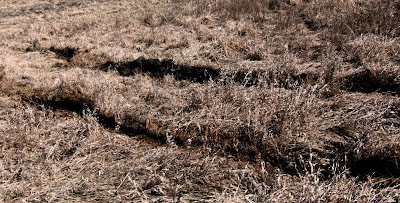
So, for the time being our farm is now "Muddyfield Farm". It is actually a good description for the farm. In fact if you take a look at the picture above you can see the muddy ruts created when the tractor was stuck a couple weeks ago. The sad thing is that the valley where the tractor was stuck is even muddier now!

I'm just hoping we dry up enough in the next couple of weeks to get my projects done. The garden is plowed, but the rains came before I could get it disced and tilled. The front yard needs to have some dirt added and raked up so we can plant grass. I need to pull about 20 more old fence posts so I an get on with the fencing job. We need some solid ground so we can start our pole building project. And, I wouldn't mind the sun everyonce in awhile!

There is my farm update for the day ... it is muddy on Muddyfield Farm.

Wednesday, April 29, 2009

More on N1H1 (Swine Flu)

I had a few more thoughts this morning as I was reading this article on the swine flu outbreak and thinking about the comments from yesterdays post. As I said yesterday I thought it was only a matter of time before there was a connection made between confinement hog houses and the flu outbreak, regardless of whether or not the connection was real. And, I am not the least bit surprised to see that there are countries out there that have placed restrictions on American pork because of this outbreak.

High density corporate confinement agriculture is beginning to get a bit of a black eye around the world. All you have to do to realize this is take a look at all of the laws that are being put in place to change the way confinement farming is done. And, all of this is happening despite efforts of conventional agriculture groups to let the public know that their way is the best way for the livestock, the farmers, and the consumers.

But, there is one thing that is missing I believe. Sure the average consumer doesn't appreciate the smell and look of large confinement buildings. They don't like the thought of pigs being raised tightly packed together in pens. And, they are even willing to pass laws by a significant majority (sometimes) to restrict the use of crates and other things in farming.

What is missing though (I think) is the majority of people willing to pay a higher price for humanely or naturally raised pork. Until that happens they can pass all the laws they want and restrict confinement buildings in their areas, but confinement agriculture will not go away. And, each time there is an outbreak like this one (regardless if it is related to confinement buildings) the large confinement corporations will take the blame and pork prices will fall impacting farmers big and small.

At least those are my rambling thoughts this morning...

Tuesday, April 28, 2009

The Swine Flu

I figured it would just be a matter of time before I found an article looking into the link between the Swine Flu and confinement agriculture on the front page of one of the news websites. And, that time came this morning for FoxNews.com. In an article titled, "Swine Flu's Ground Zero? Residents Point to Farm," from the Associated Press we see the connection being made by a community of people somewhat close to Mexico City. Their contention is that they have been experiencing problems for a few months now because of hog confinement farm located about 5 miles north of their town.

The article is full of the townspeople blaming the farm, the farm saying that they were doing everything up to snuff, health experts saying that it could be the cause, and agricultural people saying that there are no signs of sick pigs in Mexico. Really the article gives no conclusion either way and just throws out the possibility that this is the case.

What really hit me though was this quote from the farm manager, "All of our pigs have been adequately vaccinated and they are all taken care of according to current sanitation rules." I do not know if the swine flu outbreak in Mexico was caused by confinement farms (I wouldn't be surprised if it was and I wouldn't be surprised if it wasn't), but to me this statement says a lot about our culture.

We have become a culture that wants to do enough to get by and then no more. We no longer love to follow the spirit of the law, but are content to just stick to the letter of the law. Our business models very often factor in quality of life and benefits for the community, they only look at the bottom line.

And, when those ideas are applied to a farm with 15,000 pigs spread out between 18 confinement buildings I think we can have some problems. What happened to the idea that we wanted to do things as best as we could ... provide the best jobs ... the best work environment ... the best pigs ... and the best pork?

What is your take on the Swine Flu outbreak?

Monday, April 27, 2009

Two is Better Than One

One thing that I have found out about our Dexters is that when it comes to electric fence two wires seems to be better than one. A couple years ago when we were putting up the first fences to contain them out on pasture we just put up one wire low enough that both the calves and the cows would hit it ... the cows jumped over. Then we raised the wire about bit to keep the cows in ... and the calves walked under. Of course this was our main perimeter fence (there was a perimeter fence, but we didn't want them wandering that far) so we decided to go with two wires.

Last week I decided that I was going to let the five heifer calves out on some grass near their winter pen. I strung up one wire all the way around and gave them a nice sized area with plenty of grass. After about ten minutes they were walking though the fence ... and getting a little shocked. So, yesterday between rain showers I went outside and added a second wire to their fence and it seems to be working!

I do believe that once we have the perimeter fence up, and our wires have a little more juice going through them, we will be able to go back to a single strand to keep them in their area for the day. Then it won't matter so much if the calves wander away because they will have a pretty good reason to come back and we can set the height to keep the cows in.

As always I'm learning as I go by trial and error ... I seem to focus on the error.

**I would have posted a picture, but it has been raining practically non-stop for the past few days so I didn't make it out with the camera. Hopefully tomorrow.**

Saturday, April 25, 2009

The John Deere DB120

Have some spring planting to do? Need to put in your field of open-pollinated corn? Got 40 acres that you need to get planted quickly? Do you need to get that 40 acres in quickly? Why not try out the new John Deere DB120 planter. It is a 48 row planting machine that is 120 feet wide (30 inch rows) and that 40 acre field you need to plant ... well, that should take about thirty minutes and you might even have some time to spare when it is all said and done. On the flip side of this whole planter deal, I was recently give a one row garden planter (similar to this one). And, I was pretty excited about it.

I actually don't mind this huge planter on one level because it is made by an Iowa company (not John Deere), and I don't really want to go on about other things related to the fact that it exists. I'm sure John Deere is making it because there is a need and I hope things go well for them with the sales. But, what is mind boggling to me is this...

The cost (that I was able to find online) is $345,000. I saw that and then I really started to think ... $345,000 ... Wow, I could buy 80 acres of pasture with a house and buildings, some livestock, some equipment, and other things I need to build a small farm. In fact if I diversified that small farm and did some market gardening along with livestock through direct marketing I could also probably make a living for my family.

Imagine the 10,000 acres of land that many of the farmers buying this planter are farming split up into 200 acre small and diverse family farms providing food for their communities. That would be 50 family farms ... I think that would be pretty cool, but I'm sure that there are plenty of people out there more intelligent that I am that could show me how it just wouldn't work...

Friday, April 24, 2009

Can't Keep Up...


How many hours are there in a day ... all I know is that there isn't enough this time of year. All of the responsibilities are starting to add up, and there is still a ton that needs to be done on the farm. But, there is some good news. The storm shelter is being installed today, of course that also makes more work in the form of building doors for it and doing some landscaping around it. Oh well... Here are some pictures from around the farm.

Thursday, April 23, 2009

Equipment for the Small Farm

This morning I was checking out the Practical Farmers of Iowa website to see if they had any information up on this year's field days (they didn't, but I'll keep checking). But, I did find an interesting workshop, in Fairbury, Illinois, sponsored by the Illinois Farm Beginnings program. The workshop is on Saturday, May 23rd from 10:00 AM until 2:00 PM and it is all about equipment for small farmers. According to the description at this link they will talk about how the small farmer can us old and new equipment in creative ways and how you can even do it inexpensively.

I doubt that I will be able to make it to this event considering that it is about 300 miles away, but if you happen to be in that area it might be something to check out. It does bring up a good discussion question ... if you feel like discussing today?

What are some pieces of equipment that you feel the small diverse farm needs to get going, and are there any creative ways that you can use older equipment? I know one thing for sure, if you keep your eyes open and look for the smaller equipment (horse drawn or otherwise) you can often find a good deal ... or even better pick up something for free.

So far on our farm we have the tractor, small plow, haybine, rake, baler, post hole digger, two barge boxes, two hay racks, and we are in the process of picking up a small disc (that needs a little work). With this equipment that we have acquired for a relatively small amount of money (excluding the tractor) we will be able to provide our own hay from the farm, set up fences, work the garden up, do general work around the farm, and even save some feed bill money by buying corn directly from the field at times. I am pleased with our small line of equipment.

Wednesday, April 22, 2009

The Farming Soccer Coach, and Free Stuff

By the end of this week I will be half way through the soccer season (it really is going quickly). Of course that means that we are not that far away from summer and their is still a lot of work to do on the farm ... stuff that I wanted to get done during the "spring". So, I'm going to have to ratchet up the work level a bit and take advantage of all the sunny evenings that don't include a soccer game. With that being said, one thing that you need for just about every project is materials. During our last class of the Grow Your Small Market Farm program our teacher pointed out a great site to locate some stuff that could come in handy on the farm.

The site is through the Iowa DNR and is actually a waste management site that contains listings of all sorts of stuff that businesses (of some sort) are needing to get rid of. She said most of the time the stuff can be had for next to nothing or even for nothing. You can check out the link above and see for yourself what is available, but I have found some good listings for pallets and dimensional lumber that I want to check out.

Of course I also you Freecycle and even Craigslist, but do you know of any other sites like this to help reuse materials. It seems that something like this would be a farmers best friend!

Tuesday, April 21, 2009

A Couple More Movies...

While looking up a movie preview yesterday I found a trailer for a new movie called, "Food, INC." As described on the Apple Quicktime site this documentary, "lifts the veil on our nation’s food industry, exposing the highly mechanized underbelly that’s been hidden from the American consumer with the consent of our government’s regulatory agencies, USDA and FDA." As you can see from the trailer below it appears to be an interesting movie that includes a few of the usual suspects when it comes to this type of film (Joel Salatin and Michael Pollan).

My one hope is that comes across as well as "King Corn". I think those guys did an excellent job of putting together a documentary that was not heavy-handed or forceful in it's agenda. They were able to present the facts and build a persuading argument through them. Hopefully "Food, INC." is able to do the same thing! (As a side note you can watch the opening of the film here)


On a related note while looking for "Food, INC." clips on YouTube I ran across another documentary titled, "Shall We Gather at the River." I couldn't find as much about this film, but it is along the same lines as other "food and farming" documentaries coming out now. You can watch a trailer below.

Monday, April 20, 2009

Plow Day 2009


I would say that the fall is the time of the year that most people get out the plow (the ground is usually much more dry), but since there were piggies living in the spot that I wanted to plow I had to wait until the spring (and a dry week). As you can see from the picture above, the stars aligned last Friday and I was able to get the two-bottom plow in the ground and turn over the dirt in the old pig pen.

Not only did I plow up our garden spot, but I also went and hit the neighbors garden spot with the plow. I was amazed at the difference in the ground between our two spots. Ours had some decent black dirt (and composting manure), while the neighbors was sod being turned over for the first time and it was almost completely clay. And, the two spots weren't much more than a quarter of a mile apart. Although, by the bricks we found after turning of the dirt at the neighbors I wouldn't be surprised if that spot had once had an old shed or if it was even the garbage pile at one time.

The next step is to hit it with a disc and then come back with the garden tiller if it still needs to be broken up a bit. In the future we won't have to do as much work, but since this is a first year garden and because it was hard-packed by the pigs it needs a little more tillage to break it up. After all that is done we get ready to plant sweet corn ... I can't wait!

Saturday, April 18, 2009

The Cows are Out ... Again!

Yesterday morning they didn't have school in town so I was able to have soccer practice in the morning at 9:00 AM. I look forward to days like that because then I can get soccer in and move on with the day. But, this particular day practice came at just the wrong time ... just before I was ready to start the phone rang and my wife told me, "the cows are out ... again". I told her to try and keep them on the farm and that I would come home as soon as I could. Luckily only three were able to make the escape, led by the new bull of course.

Being completely honest, our fence really isn't the best but mostly it has been good enough. Rather it has been mostly good enough until the new bull showed up. He likes to test fences and find the weak spots. He has led many revolutions!

Anyways, back to the latest escape. On my way home from soccer practice I was happy to find out that Becca had gotten the two cows back in and that only the bull was still out. He was just contentedly eating grass down in the valley. When I pulled into the drive ... out walked my wife in her muck boots holding a baseball bat (you have to have the proper accouterments when working with a bully bull).

This time though he was very easy to work with. I walked down to the valley, circled around behind him and basically walked him up and into the pen. It was actually pretty surprising! But, I decided that maybe something should be done to stop this from becoming a daily thing so I stopped by the farm store and picked up some poly wire and step-in posts. Now we can put a hot wire around the inside of the pen ... and reacquaint them with electric fence.

Friday, April 17, 2009

A Passionate Essay...

I found this over on Allan Nation's blog:
"The Japanese government said agriculture is one of the few industry’s that could provide much needed jobs in the current economic environment and has earmarked $10 million to send 900 young, unemployed workers to farm training schools. So far, there have been ten prospects for each slot. Each candidate must write a passionate essay about why they want to be farmers to be considered. "
Mr. Nation's post continues on to say that 2 out of 3 Japanese farmers are over the age of 65 and that one Japanese economist believes that if that trend isn't reversed. Of course if Japan's agricultural system goes like ours here in the U.S. they won't need to replace all those farmers they are losing because the farms and everything else will get bigger. But, that is a discussion for another day (I don't have the energy to think about it now).

What really hit me after reading that quote was the essay thing. If I had a 10% chance to getting the farming job and had to write an essay in order to secure the position that I passionately wanted what would I say?

Would I talk about the family that I need to provide money for (which may be one of the top things in Japan at the moment)? Would I discuss my love for the land and the food we eat? Would I make sure to touch on the importance of keeping food production in our own country? What exactly would I write about...

I think that thought is an interesting one, and probably it is even one that all farmers (or beginning farmers) should think about from time to time. One big thing of mine is that we need to work in our passions, so if I cannot be passionate about farming (and the way I farm) then I don't think I should farm because I probably won't be as successful as someone that is completely sold out on what they are doing.

My question to you ... What would you write in your passionate essay?

Thursday, April 16, 2009

Blue is Back...

I just thought I would give a quick farm update this morning before I head out for another crazy day. I have lots to catch up on at work today and then a Junior Varsity/Varsity soccer double header this evening. Should be a busy day! But, there is good news to report on the farm so I thought I would take a second to share a little before I hit the dusty roads to town.

The Pigs are Being Pigs: Really, that is about it. They are eating, lounging around, sleeping, and really not rooting up to much (which is nice). I really like the temperament of these pigs and especially of the sow. They had been worked with to a point and were fed daily by hand so they are used to people being around. I think they will make some nice pork!

The Cows are Being Cows: They are still in the "lot" right now eating hay because the fencing isn't up yet, but the grass isn't totally around yet either so that isn't a huge problem. I have been toying with the idea of letting them out during the day into an electrified paddock to see if they will trample down and eat some of the tall grass ... we will see.

The Chickens are Being Chickens: Really we only have three chickens right now and we only know where one is laying at the moment. But, since she is laying consistently we have enough eggs to get by. It is nice to see them out in the cow lot flipping over cow pies and digging around though, and that only serves to get me excited about getting more. Hopefully we will take a trip north soon (to my uncle's) to expand the flock.

Blue is Back: I am happy to say that our "new to us" Ford 5000 tractor is back from the shop as of yesterday and I am ready to put her to work. It seems the folks at Belzer Equipment did a good job on the repairs and I know that they were very good to us on the bill. When it was all said and done they fixed the lights, put a new seal kit on the steering cylinder (the reason it went in), replaced the temperature sender, replaced the fuel pump, adjusted the pump timing, and a replaced a couple other small things. Between that and the engine overhaul I think we should have a pretty good tractor! I know there will eventually be something that wears out again, but at least we know we have some things fixed up!

Other than that, plans are going well for the various projects that need to be done this spring. We have the storm shelter deal all figured out and are just waiting for some dry ground, I'm waiting on a bid for our shed, fencing things are coming together (I just need to carve out some time), and we are enjoying spring days on the farm as a family (when we are all home together).

Wednesday, April 15, 2009

Happy Birthday!

Today is my sons 5th birthday. It is incredibly hard to believe that he is turning five, but I'm sure that he will keep reminding me all day long (he is pretty excited about the day). One thing that I do know though is that I am very blessed to have him in my life and can't imagine life any other way. In fact one major part of our move to the farm and the idea behind building a farm is because we want our family to experience all that the farm has to offer (everything from work to play).

My son is already a great helper around the farm. He helps water the livestock by turning on the hydrant, he helps feed the calves hay with me, he loves to carry wood, and he is the best buddy a dad could have when out doing chores.

With all of that in mind ... I'm off to spend the day with my little guy ... I'm sure he won't be little for much longer!
Related Posts Plugin for WordPress, Blogger...